Victorian Samhain Gathering Guide

Victorian Samhain Gathering Guide

PRACTICAL MAGIC · SEASONAL GATHERINGS


How to Host an Elegant Victorian Samhain Gathering

A practical guide to creating an evening that feels intentional, atmospheric and unmistakably Samhain—from the first invitation to the final farewell.


THE MOON GARDEN ART HOSTING GUIDE

THE SIMPLE FORMULA

Make it more than a beautiful dinner

A Samhain gathering becomes distinctive through four deliberate moments: a threshold, a seasonal feast, a space for remembrance and a meaningful farewell. You bring the guests and the food. The Victorian Samhain Gathering Collection brings every visual detail together.

01 · Threshold

Invite guests into another enchanted world.

02 · Feast

Make the season visible at the table.

03 · Remembrance

Create one quiet, meaningful ritual.

04 · Farewell

End with gratitude and a keepsake.
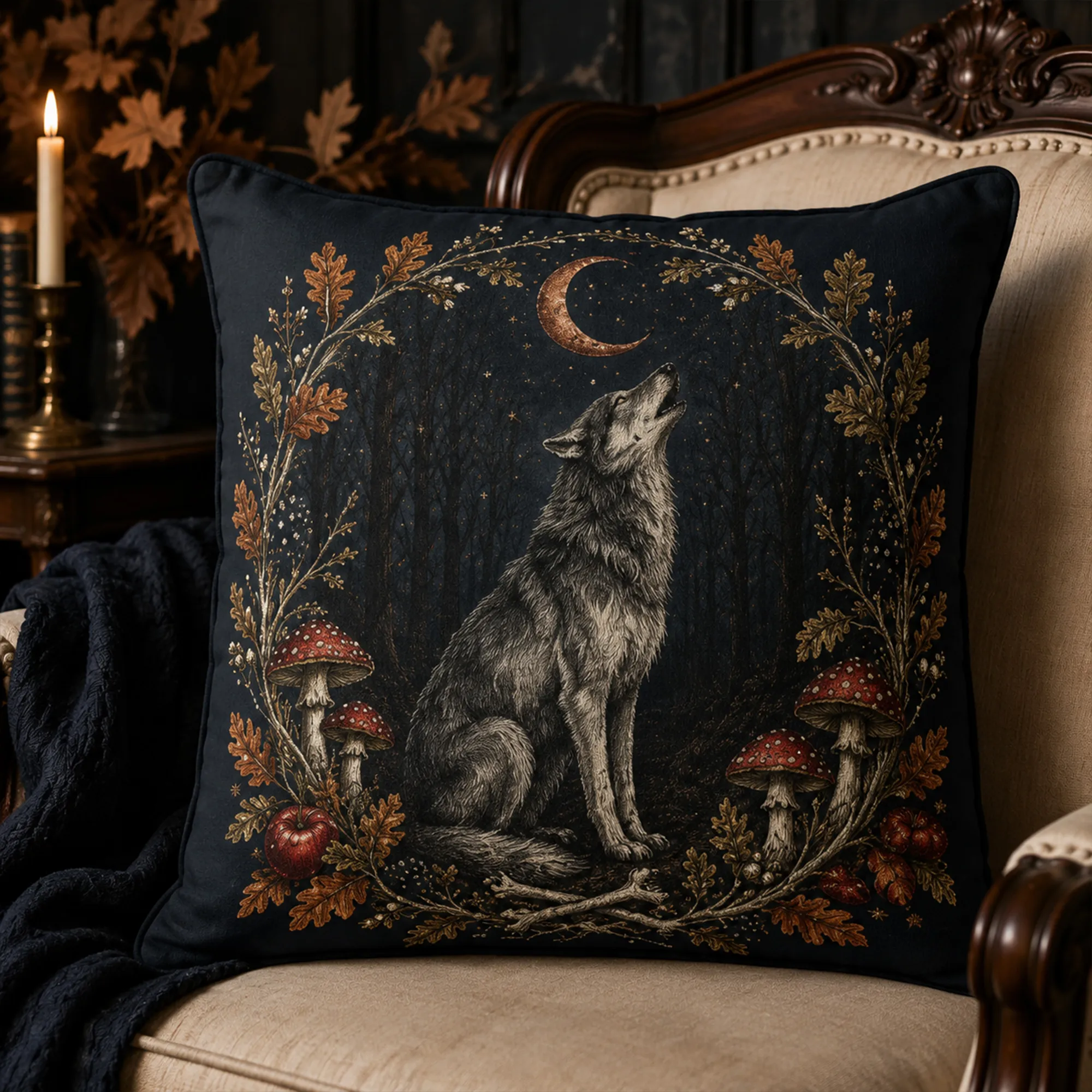
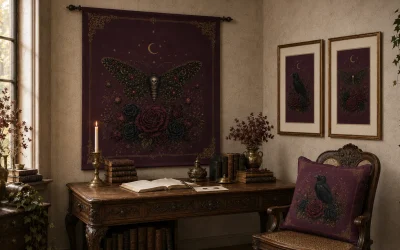
Antique plum raven floral pillow styled on a carved Victorian chair

BEGIN BEFORE THE EVENING

Set the expectation with the invitation.

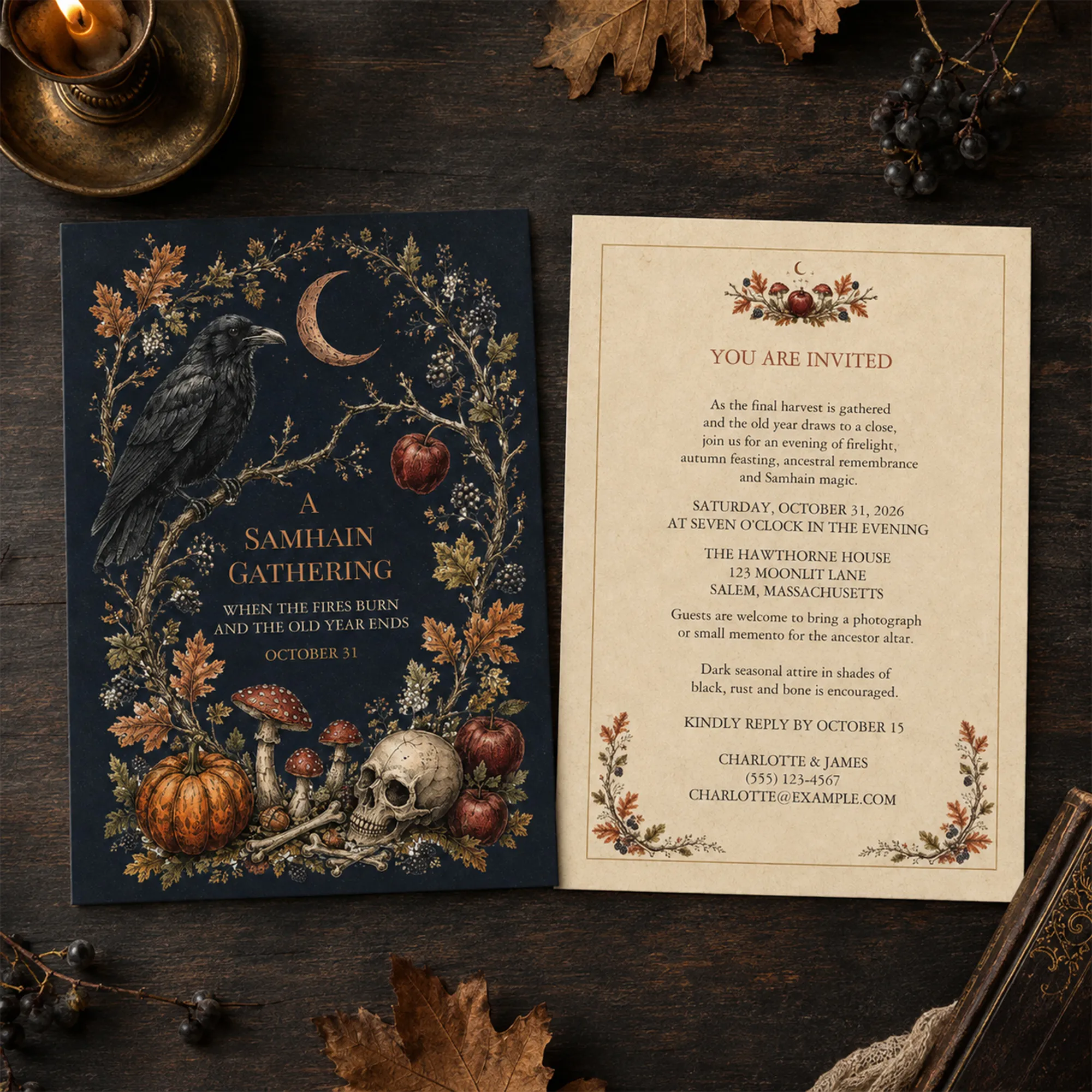
Your gathering starts the moment the invitation arrives. Give guests the practical details, then add one line that signals the mood: candlelit supper, Victorian-inspired dress, or an evening of feasting and remembrance.

  • Name the occasion clearly: a Samhain gathering.
  • Suggest a dark, autumnal or Victorian-inspired dress code.
  • Invite guests to bring a photograph, name or small memento for the remembrance table.

THE THREE-ZONE METHOD

Give every part of the evening a purpose.

You do not need to transform the entire home. Style three defined spaces and let the coordinated design carry the story from arrival to farewell.
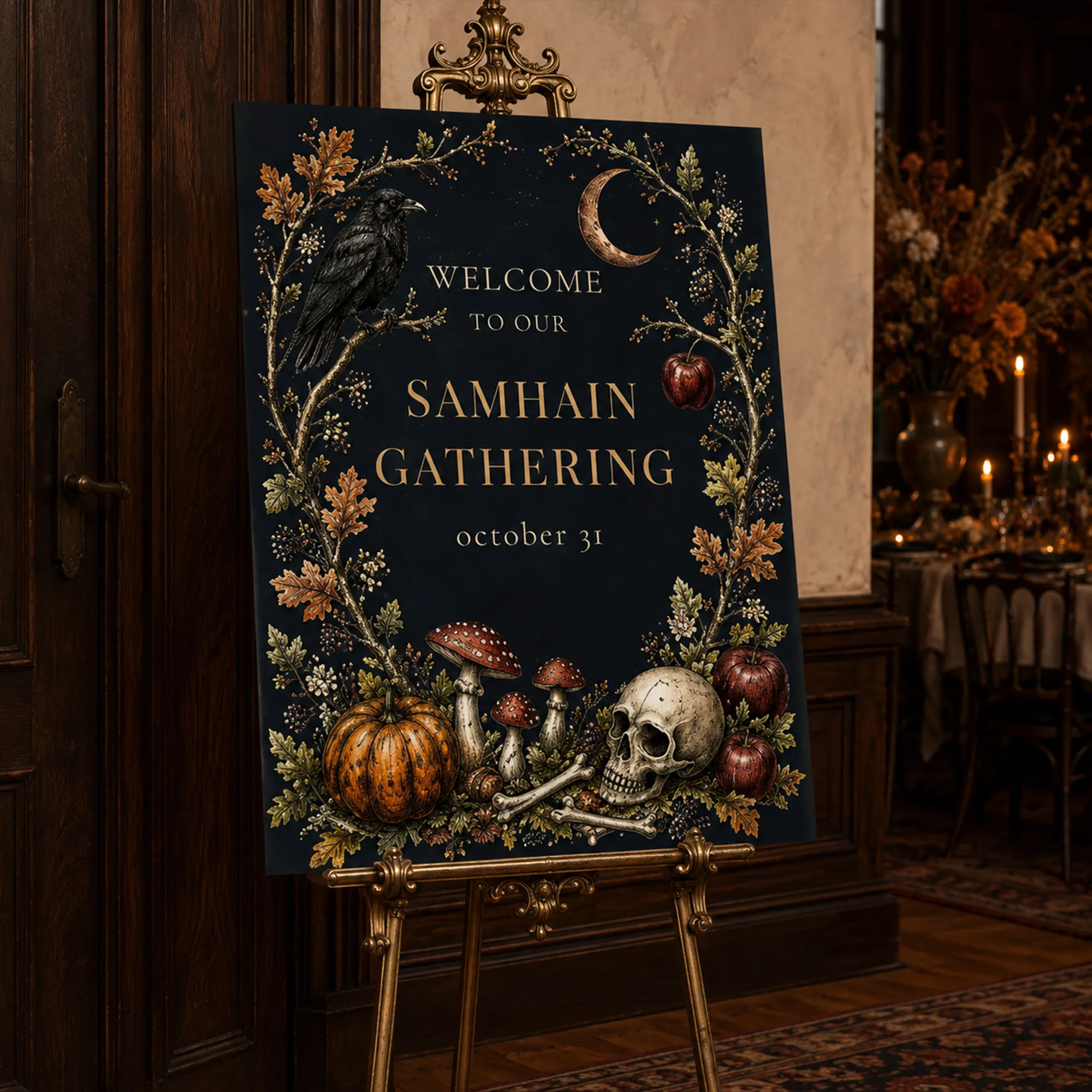
THE THRESHOLD

Welcome

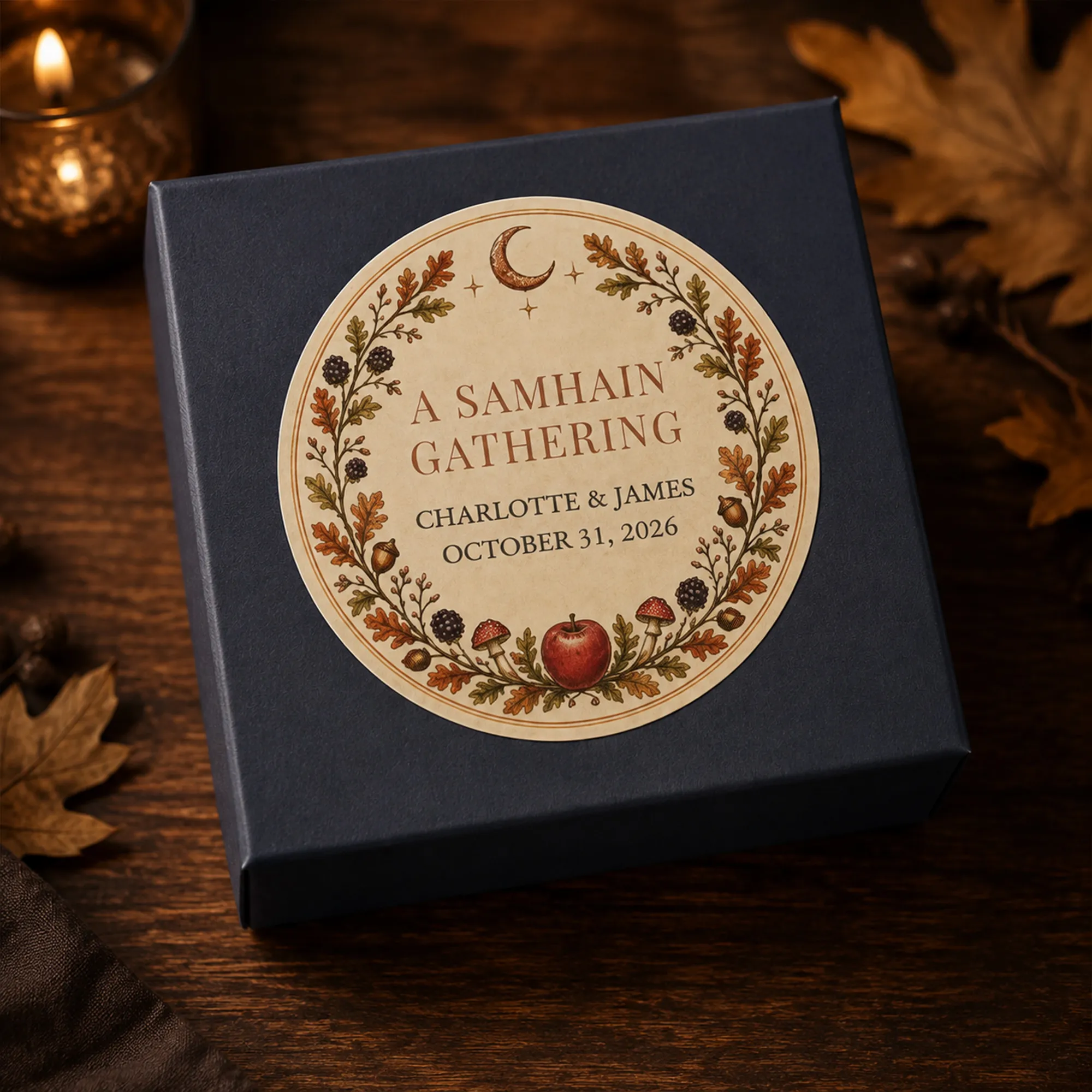
Place the welcome sign by the entrance with a lantern, fallen leaves or branches. This first detail immediately sets the mood.
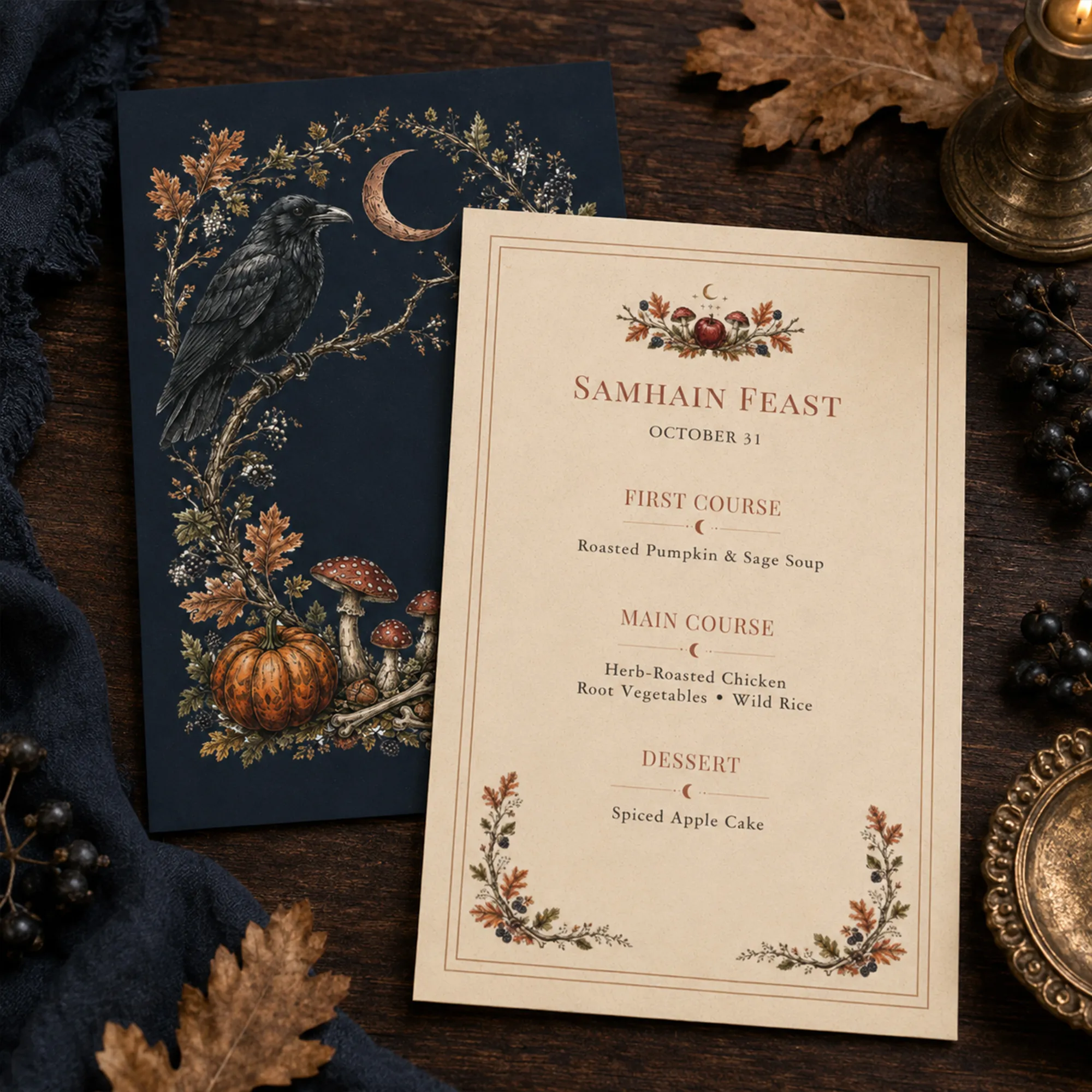
THE SHARED TABLE

Feast

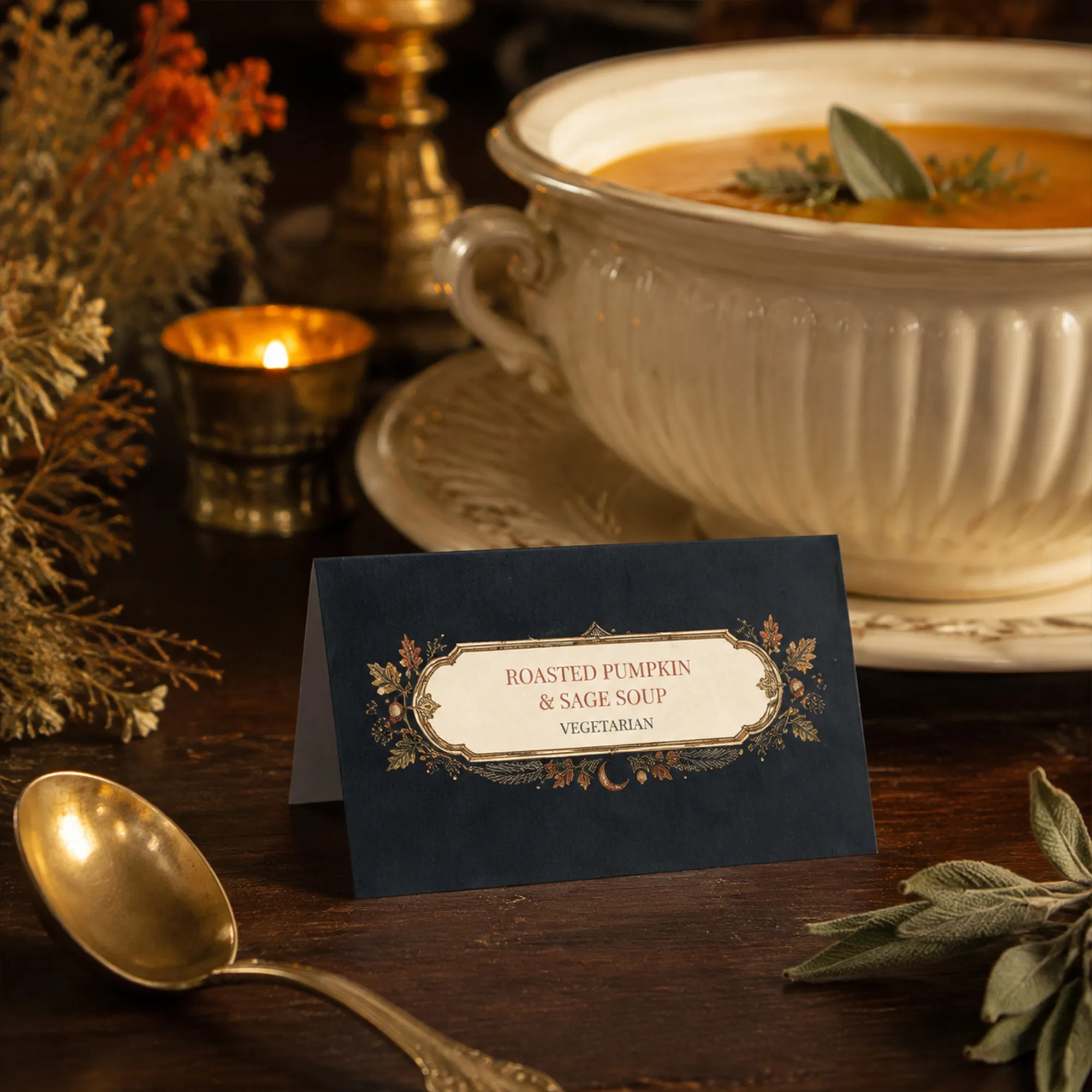
Repeat the same palette and motifs across the menu, napkins, place cards and food labels. The table immediately feels collected rather than improvised.
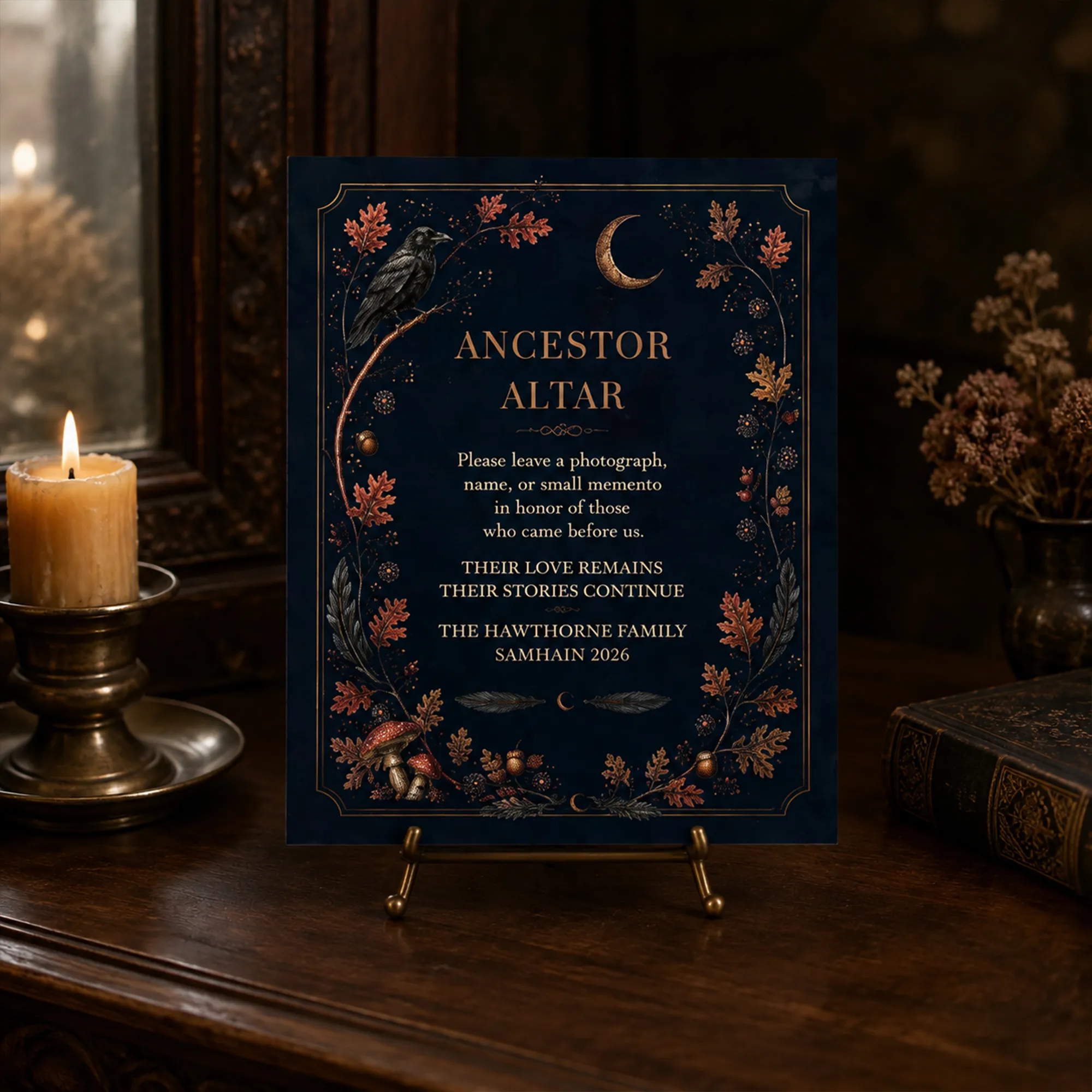
THE QUIET CORNER

Remember

Use the ancestor altar sign to identify a small side table for photographs, keepsakes, candlelight and the Book of Remembrance.

PRACTICAL TABLE STYLING

Build a feast table that explains itself.

Let each printed or textile detail do a job. The result is elegant for guests—and easier for the host.

Antique plum raven floral wall art in a vintage brass frame above a dark wood desk

Start with the menu.

It introduces the feast, reinforces the theme and gives the place setting a strong visual center. Add brass candlesticks, dark glassware, seasonal fruit and natural foliage—then stop before the table becomes crowded.
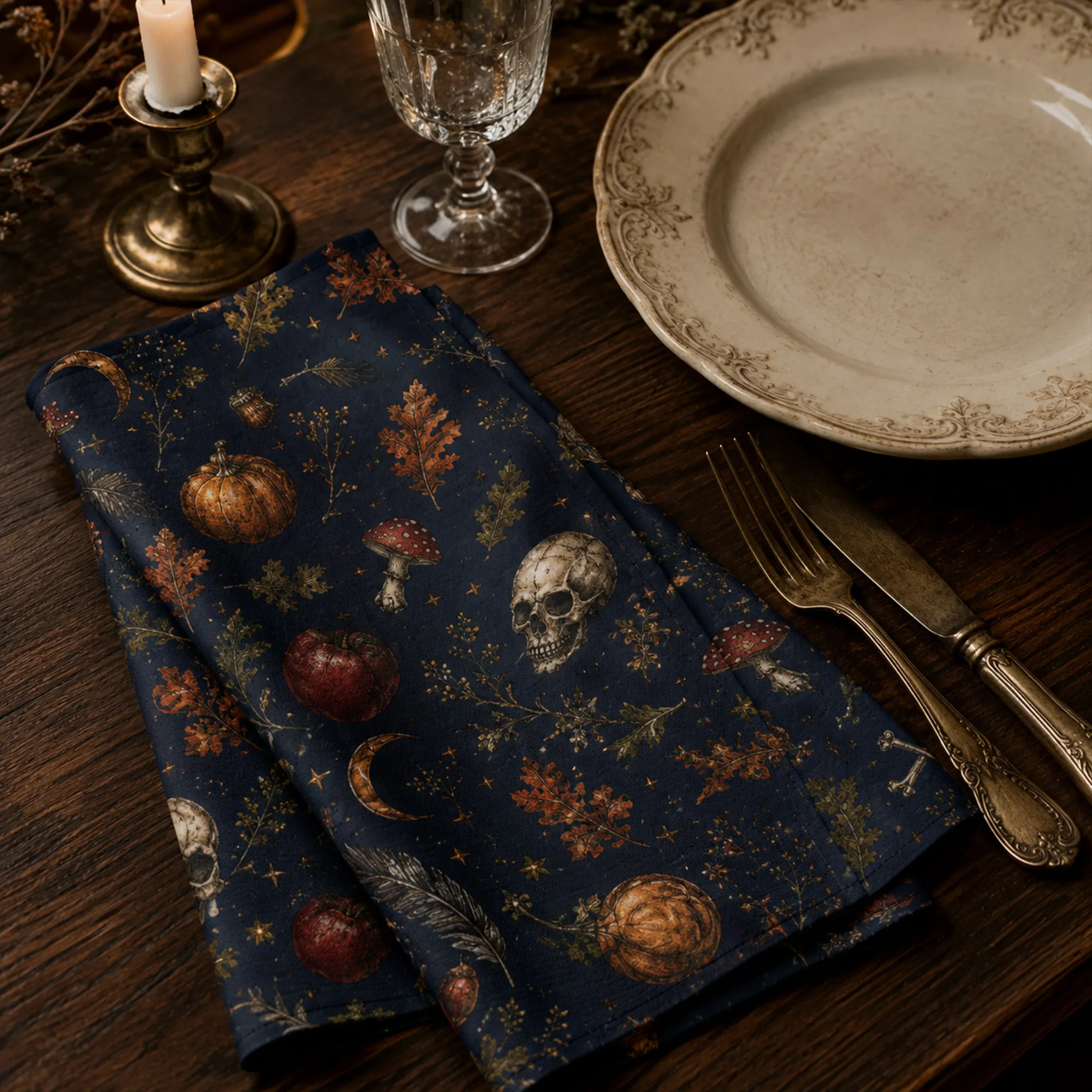
Antique plum raven floral wall art in a Victorian dark academia study corner

Cloth Napkin

Antique plum raven floral wall art in a Victorian dark academia study corner

Food Label

Antique plum raven floral wall art in a Victorian dark academia study corner

Place Card

Antique plum raven floral wall art in a Victorian dark academia study corner

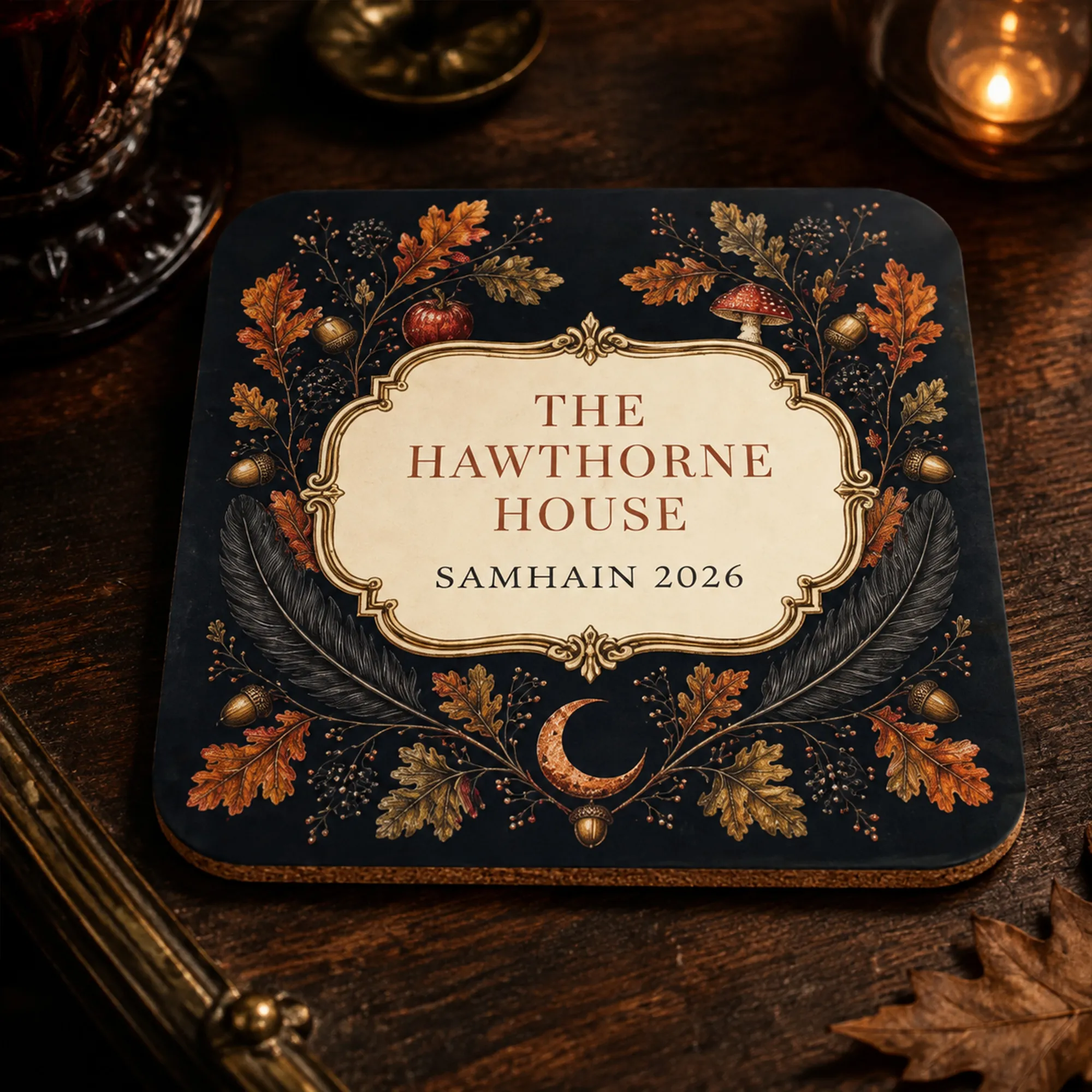
Coaster

A NATURAL ORDER FOR THE EVENING

Keep the gathering gently structured.

A simple sequence creates momentum without making the evening feel formal or over-planned.

1

Arrival

Welcome drink, candlelight and time to notice the threshold.

2

Feast

Invite everyone to the table and introduce the seasonal menu.

3

Stories

Share memories naturally as the meal comes to a close.

4

Remembrance

Offer a short toast, a written memory or a quiet candle.

5

Farewell

Thank each guest and send them home with a small favor.

ONE MEANINGFUL RITUAL IS ENOUGH

Create a place for remembrance.

The ritual does not need to be elaborate. Make participation gentle and optional, then choose one simple action that suits your guests.

A quiet focal point

Gather photographs, names, flowers and keepsakes on a side table. Light a candle there before guests arrive.
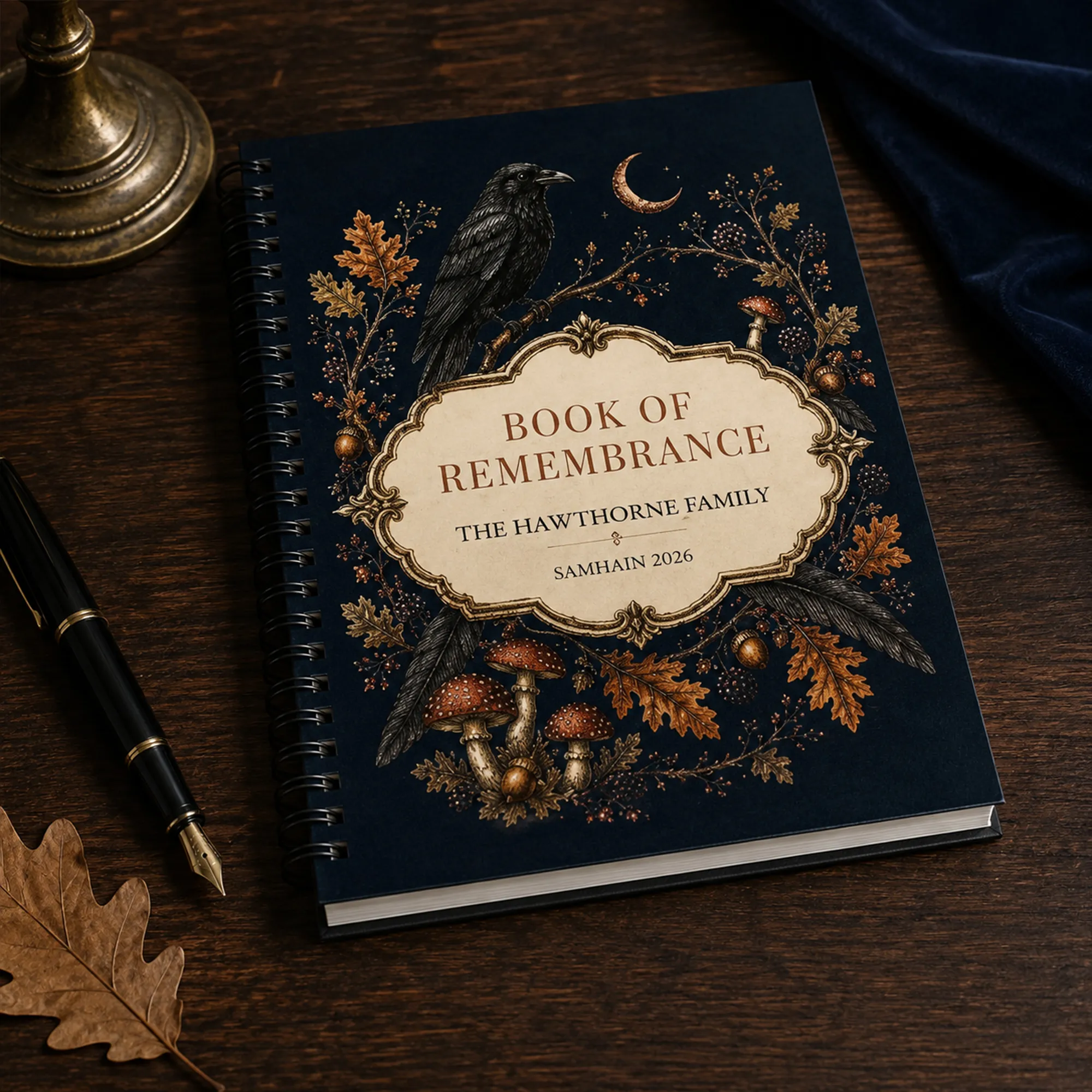
A memory to keep

Invite guests to write a name, a short memory or a message in the Book of Remembrance during the evening.

ATMOSPHERE, NOT EXCESS

Layer warmth around the gathering.

Use low, warm light and repeat the collection’s palette in a few soft furnishings. Candlelight, aged brass, dark navy, woodland green and harvest rust create the Victorian mood without turning the room into a stage set.
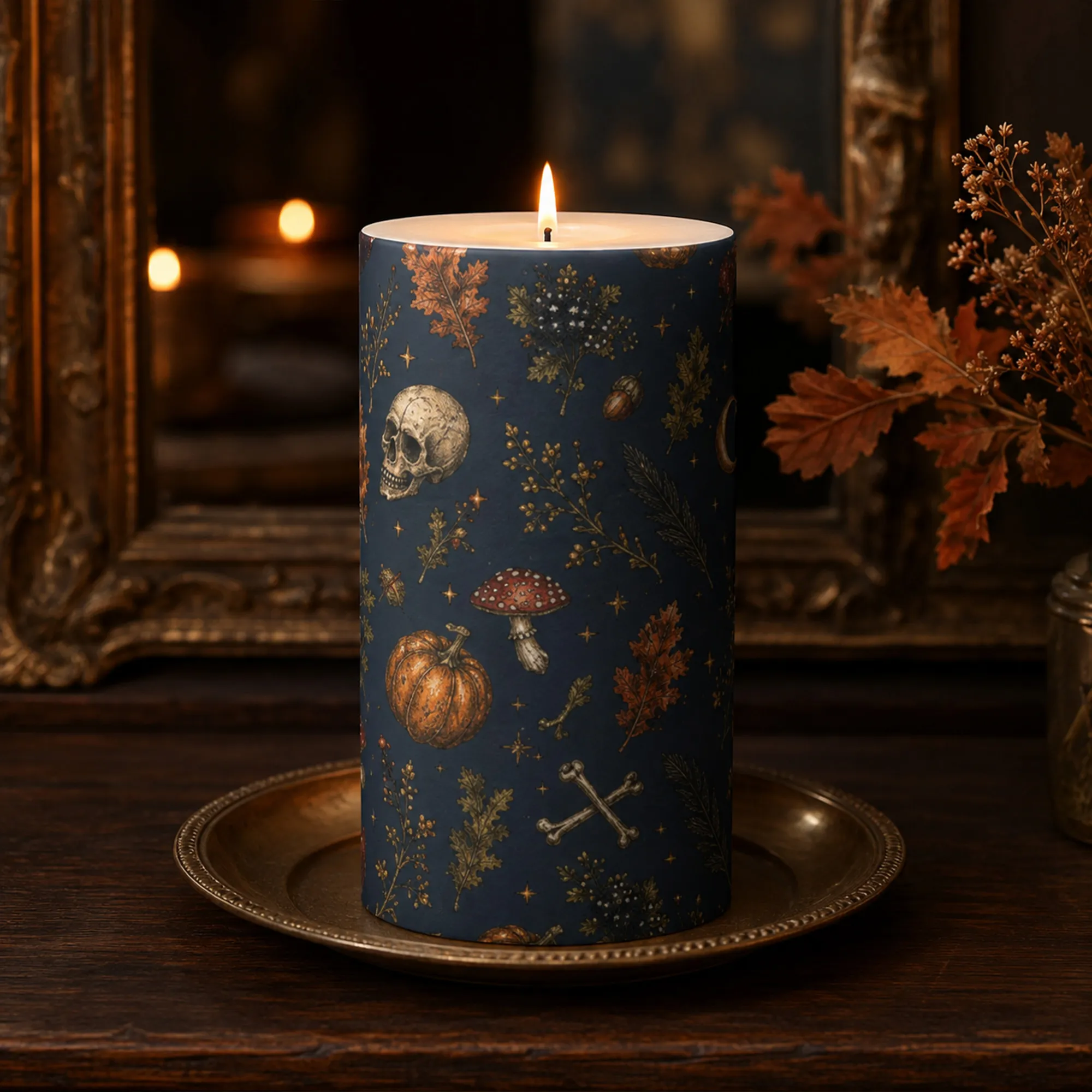

Host’s Rule

Light the candles, lower the overhead lights and finish decorating before you dress. A calm host is part of the atmosphere.
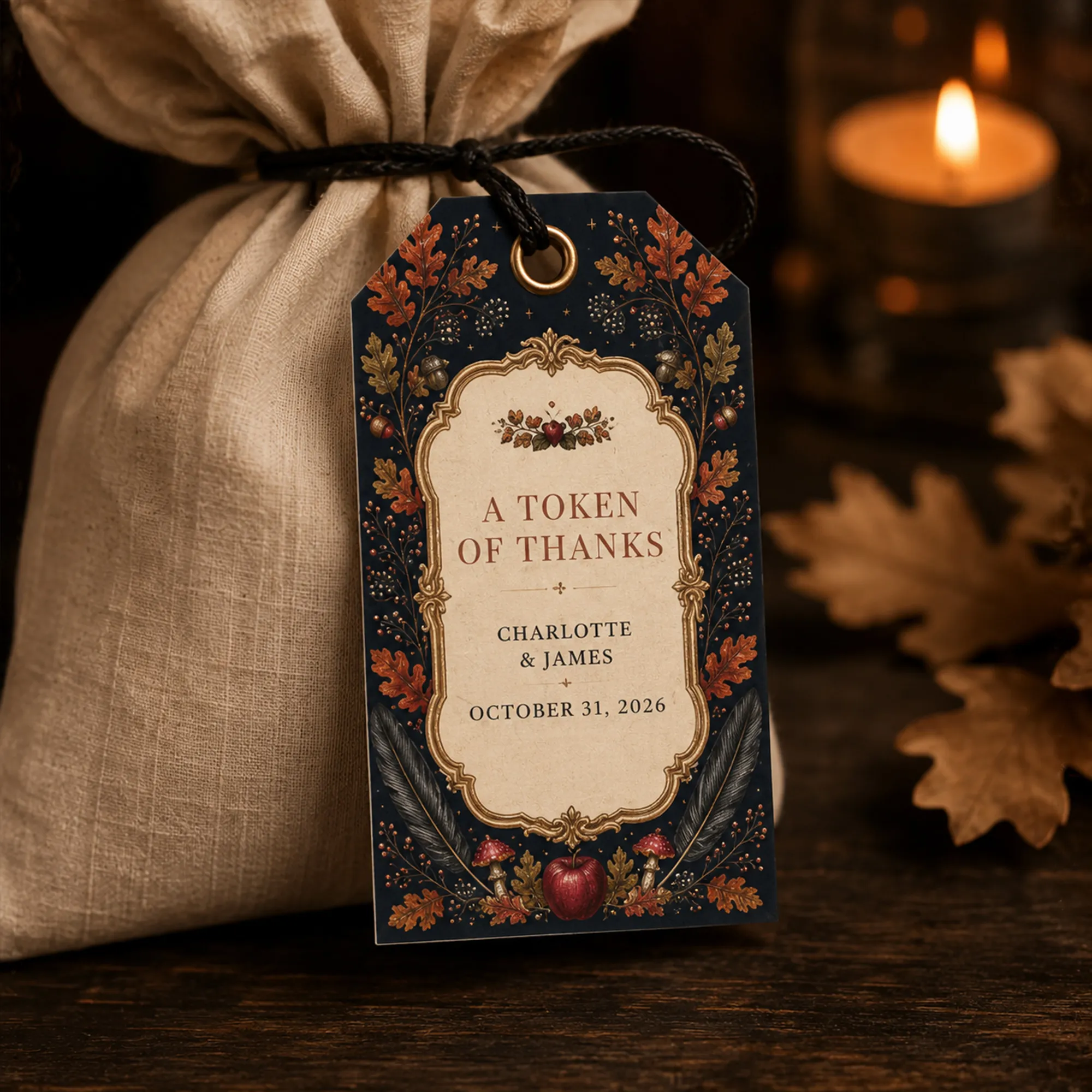

THE FINAL GESTURE

Send guests home with a little piece of the evening.

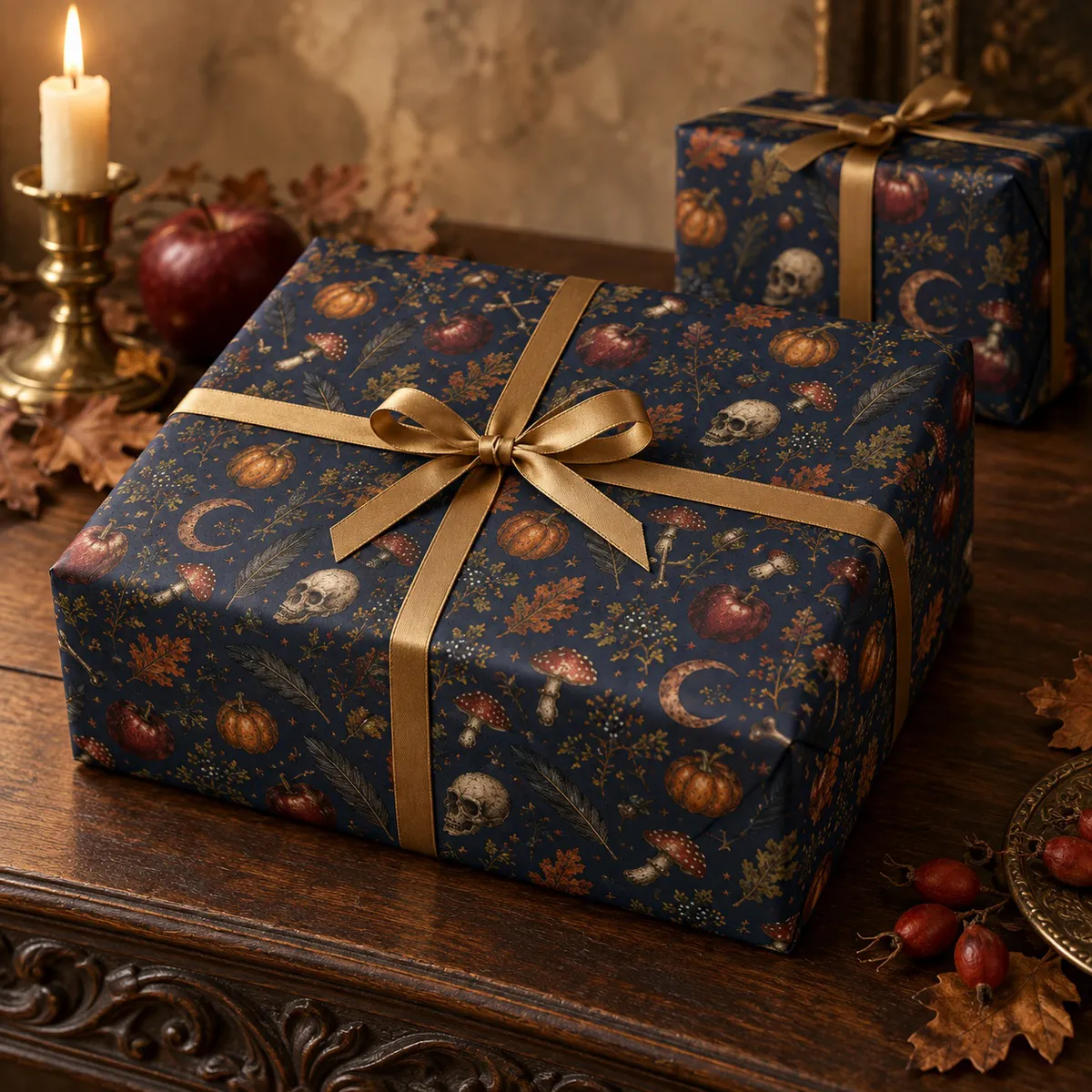
A small favor makes the farewell feel considered. Tie it with coordinating ribbon, add a favor tag and place it by each setting or near the door.

Favor ideas:

  • Spiced tea
  • Herb sachet
  • Dark chocolate
  • Small candle

Keep it simple: the thoughtful presentation is what connects the gift to the gathering.

ONE STORY · EVERY DETAIL

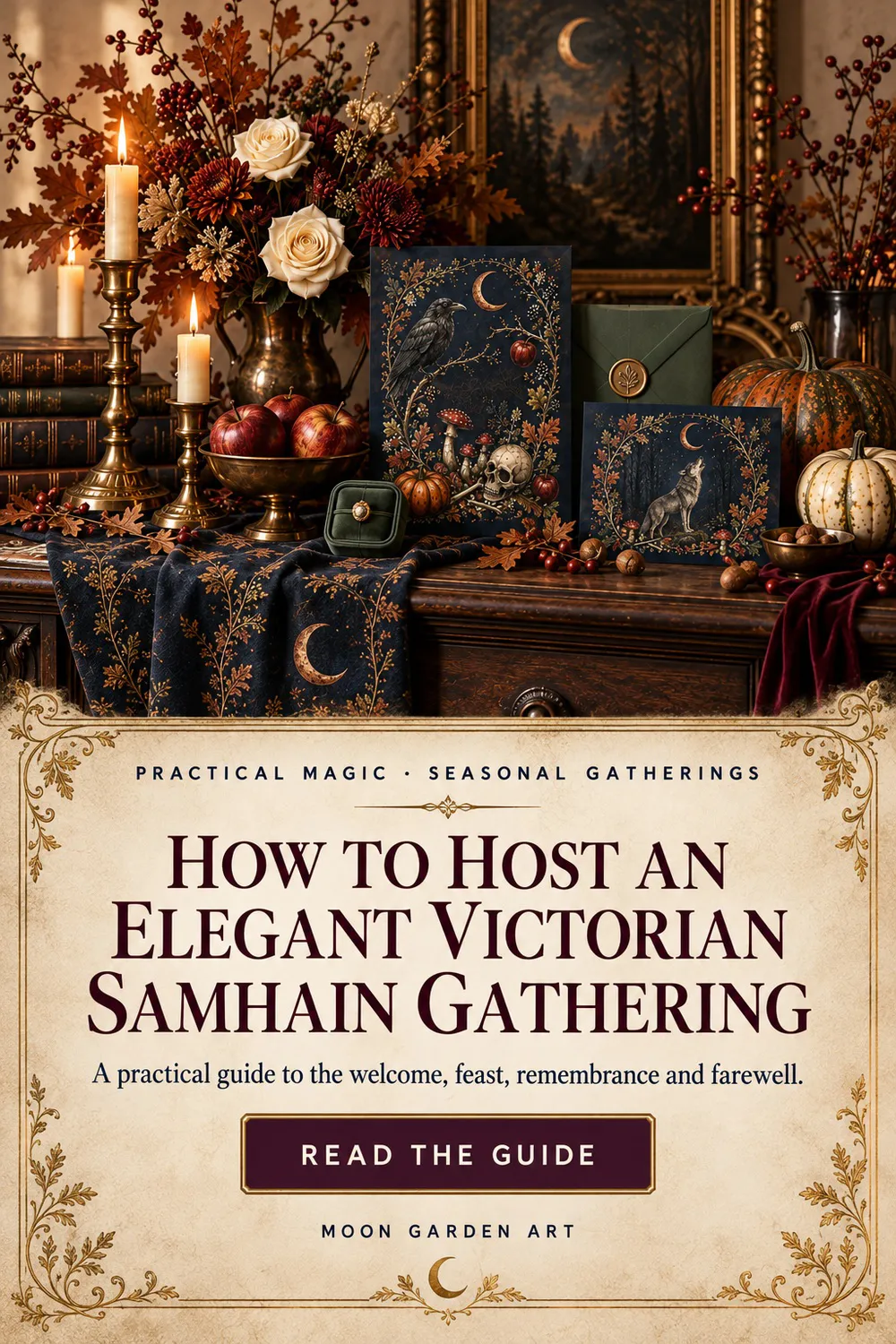
Shop the Victorian Samhain Gathering

Choose only the pieces your gathering needs, or build the complete experience from 23 coordinated designs—without searching across different styles and shops.

Featured pieces:

  • Invitation Suite
  • Welcome Sign
  • Feast Menu
  • Cloth Napkin
  • Ancestor Altar Sign
  • Favor Tag

SAVE THE COMPLETE GUIDE

Your gathering, beautifully connected.

Begin with the four moments—threshold, feast, remembrance and farewell—then select the coordinated pieces that make each moment effortless. The result will feel unmistakably Samhain and entirely your own.
Explore more soulful reads

More stories to nurture your spirit.

What Happens When You Start Living With the Seasons Again

What Happens When You Start Living With the Seasons Again

What Happens When You Start Living With the Seasons Again

Modern life often asks us to live the same way all year long.

To keep producing.
Keep moving.
Keep achieving.

No matter the season.
No matter the weather.
No matter how tired we feel inside.

We are expected to function like machines.

But nature does not work this way.

And neither do we.


Remembering That We Are Part of Nature

Somewhere along the way, many of us began living as if we existed separately from the natural world.

As if our bodies, minds, and nervous systems should operate independently from rhythm, rest, and cycles.

But we are not outside nature.

We are part of it.

And often, healing begins when we stop trying to live against our own nature.


Winter — The Season of Quiet

In winter, the days become shorter.

The world slows down.

Trees rest.
Animals conserve energy.
The earth becomes quieter.

And many people notice the same thing within themselves.

Less energy.
More introspection.
A desire for stillness.

This is not failure.

It is a natural rhythm.

Winter is not asking us to bloom.

It invites us inward.

Not necessarily into trauma processing or emotional heaviness.

Sometimes simply into reflection.

Into silence.
Rest.
Reading.
Warm drinks.
Slower mornings.
Early evenings.

Nature never asks the tree to bloom in winter.

And yet, many people expect this from themselves.


Spring — The Return of Energy

Then, slowly, the light returns.

The days grow longer.

Something begins to wake up again.

Not overnight.

But gently.

You may notice:

  • more motivation,
  • more creativity,
  • more desire to move,
  • more openness toward life.

Just like the trees begin to bud and flower, we also begin reaching outward again.

Ideas return.

Energy returns.

Hope returns.


Summer — Expansion and Aliveness

Summer carries fullness.

Growth.
Connection.
Movement.

This is often the season of creating, exploring, gathering experiences, and bringing ideas into reality.

The energy naturally moves outward.

And when we allow ourselves to fully live during these seasons of abundance, we begin storing something important internally too.

Not just memories.

But nourishment.


Autumn — Gathering and Letting Go

Autumn reminds us to slow down again.

To harvest what we have grown.

To notice what worked.
What mattered.
What sustained us.

And also:

what no longer needs to be carried forward.

There is wisdom in preparing slowly for quieter seasons.

Just like a full pantry makes winter gentler, the emotional and practical foundations we build during active seasons help us move through harder periods with more trust and stability.


This Is Not Meant to Become Another Rule

Living seasonally does not mean forcing yourself into rigid routines.

It is not another system to perform perfectly.

These rhythms are not commands.

They are invitations.

Gentle frameworks.

Ways of listening more closely to yourself and the world around you.

Some winters may feel lighter.
Some summers may feel quiet.

And that is okay too.

The point is not perfection.

The point is awareness.


Returning to Rhythm

Many people are exhausted because they have spent years pushing against themselves.

Ignoring tiredness.
Ignoring limits.
Ignoring the need for rest, quiet, or slowness.

But nature teaches something different.

Everything has its season.

Everything has its time.

Rest is not separate from growth.

It is part of growth.

And perhaps life becomes softer when we stop asking ourselves to bloom constantly.


A Quiet Reminder

You do not need to live in perfect harmony with nature to begin reconnecting with it.

Sometimes it starts very simply.

Opening the window in the morning.
Noticing the changing light.
Walking without headphones.
Watching the trees move in the wind.

Small moments of remembering.

That you are not separate from this world.

You belong to it.

Explore more soulful reads

More stories to nurture your spirit.

From Samhain to Beltane — The Path You’ve Already Walked

From Samhain to Beltane — The Path You’ve Already Walked

From Samhain to Beltane

The Path You’ve Already Walked

There is a path many of us walk without fully realizing it.

It does not begin with light.

It begins in the dark.


Stepping Into the Dark — Samhain

There was a moment when something in you turned inward.

Not because it was easy.

But because it became necessary.

You began to see what you had been carrying.

Old pain.
Old patterns.
Old stories.

Things that could no longer be ignored.

You stood at that threshold and chose to look.

(Samhain — The Courage to Step into the Dark and Let Go)

The Quiet That Follows — Winter

After that, there was quiet.

Not peaceful at first.

Uncertain.
Heavy.
Still.

The kind of quiet where everything slows down and you are left with what is there.

You met parts of yourself that had been waiting to be seen.

The inner child.
The fear.
The tension you carried for so long.

There was no need to rush.

Only to stay.

(The Healing Quiet of Yule)
(The Pause Between Breaths — A Quiet Moment Before Yule)


The First Light — Imbolc

And then, something shifted.

Not everything.
Just enough.

A small light.

A quiet sense that something could be different.

You began to feel what you no longer wanted to carry.

And slowly—what you might want instead.

Hope did not arrive loudly.

It came as a possibility.

(Imbolc — Tending the First Light)

Finding Balance — Ostara

With time, there was more movement.

More awareness.

Light and shadow existing at the same time.

You were no longer only reacting.

You were beginning to choose.

To see patterns as they happened.

To pause.

To respond differently.

Not perfectly.

But intentionally.

(Ostara: Where Light and Shadow Meet)

The Work No One Sees — Early Spring

Much of what changed was not visible from the outside.

There were no dramatic transformations.

Only small, repeated moments.

Returning to yourself.
Trying again.
Staying a little longer.

You built something quiet.

Structure.
Awareness.
A different way of being.

Even when it felt slow.

Even when it felt like nothing was happening.

(Returning Gently: Coming back without leaving yourself behind)
(Tending the Flame — Gentle Habits, Quiet Hope, and the Courage to Stay)
(Gathering the Light: Resources for the New Cycle)

Stepping Into Life — Beltane

And now—something opens.

Not because everything is finished.

Not because everything is healed.

But because something in you is ready.

Ready to live differently.
Ready to move.
Ready to say yes.

This is where life begins to meet you again.

Not as something to survive.

But as something to enter.

(Beltane — When Life Wants to Be Lived Again)

You Didn’t Just Arrive Here

This moment did not come out of nowhere.

The clarity you feel now.
The strength.
The quiet readiness.

It was built.

In the dark.
In the stillness.
In the moments no one saw.

In the times you stayed when it would have been easier to leave.


You Are Not Starting — You Are Continuing

It may feel like a beginning.

But it is not.

You are not starting from nothing.

You are stepping into something that has been growing in you for a long time.


You Don’t Have to Be Ready

And even now—you do not have to be fully healed.

You do not have to be complete.
Or perfect.
Or finished.

You are allowed to step into life while you are still becoming.

You are allowed to feel joy before everything is resolved.

Because joy is not something you earn.

It is something that has always been part of being alive.


Closing

What you are ready to live now was not created in a single moment.

It was grown.

Quietly.
Patiently.
Within you.

And now—you are simply stepping into it.


Explore more soulful reads

More stories to nurture your spirit.

Beltane — When Life Wants to Be Lived Again

Beltane — When Life Wants to Be Lived Again

Beltane — When Life Wants to Be Lived Again

There is a moment in spring when something begins to shift.

Not suddenly.
Not loudly.

But undeniably.

The air softens.
The light lingers longer.
The world begins to open.

This is the energy of Beltane.

When Life Starts Calling Again

Beltane is not something you have to understand.

It is something you can feel.

In the warmth of the sun.
In the quiet return of desire.
In the gentle sense that something inside you
is ready to live again.

Healing Is Not Only About Letting Go

There is a part of healing that is about release.

About boundaries.
About safety.
About learning to stay.

But there is another part that comes later.

Quieter.
Softer.

And sometimes, more unfamiliar.

The Return of Aliveness

At some point, healing is no longer only about pain.

It becomes about life.

About feeling again.

About wanting again.

About opening to something more than survival.

You Don’t Have to Be Ready

And this is where something important needs to be said.

You do not have to be fully healed to allow yourself joy.

You do not have to be complete.
Or perfect.
Or finished.

You do not have to reach some final version of yourself before you are allowed to feel good.

Joy Is Not Something You Earn

Joy is not a reward.

It is not something waiting for you at the end of a long process.

It is not something reserved for the version of you who has everything figured out.

Joy is part of being alive.

It always was.

Letting Life In, Gently

Sometimes, after everything you have been through, joy can feel unfamiliar — especially if receiving or allowing something good once felt unsafe.

Even unsafe.

Like something that might disappear.
Or cost something.

But Beltane reminds us of something simple:

Life does not ask you to be ready — it only invites you to return to yourself, gently.

It invites you to be present.


The World Is Already Blooming

Flowers do not wait until they are perfect.

They do not ask if they are ready.

They open.

Because it is their nature.

And maybe, this is yours too.


A Gentle Beltane Ritual 🔥🌿

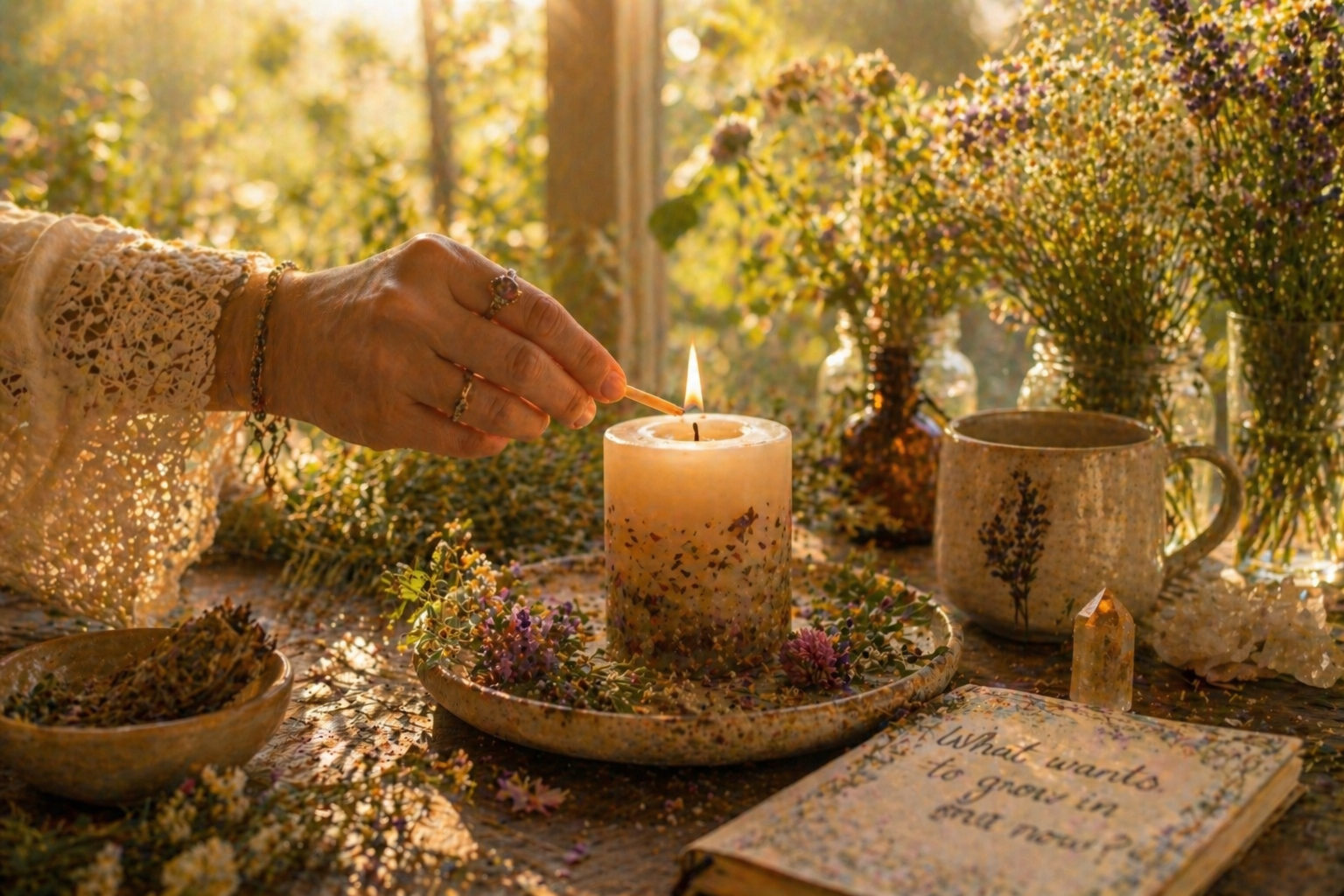
Ritual candle and journal

You do not need anything elaborate.

Just a quiet moment.

Light a candle.
Or step outside.
Or simply pause.

And ask yourself:

What wants to grow in me now?

You don’t need a full answer.

Just notice.

And maybe— say yes to something small.

Closing

You are allowed to feel joy before everything is resolved — even if a part of you still believes it has to be earned.

You are allowed to live before everything is perfect.

You are allowed to open even while you are still healing.

Because life is not something you have to earn.

It is something you are already part of.

Explore more soulful reads

More stories to nurture your spirit.

Ostara: Where Light and Shadow Meet

Ostara: Where Light and Shadow Meet

The Exhaustion After Letting Go of Control

There is a moment in early spring when the light and the dark stand in perfect balance.

Not one stronger than the other.
Not one winning over the other.

Just… equal.

This is the essence of Ostara.

Not the Triumph of Light

We often think of spring as the return of light.

The end of darkness.
The beginning of something better.

But Ostara is not about victory.

It is about balance.

Light and shadow existing side by side, without one needing to erase the other.

The Parts We Were Taught to Hide

Many of us learned, in different ways, that certain feelings are not acceptable.

Anger.
Fear.
Pain.

We were taught to suppress them.
Or to feel ashamed of them.

As if these parts of us were somehow wrong.

But these feelings are not here to harm us.

They are signals.

Anger may tell us that a boundary has been crossed.
Fear may show us where we do not feel safe.
Pain may reveal where something matters deeply.

They are not enemies.

They are messengers.

The Shadow Is Not the Opposite of Light

If something stands in the light, it casts a shadow.

This is not a flaw.

It is a natural consequence of existence.

The same is true within us.

There is no part of us that is only light.
And no part that is only shadow.

Both are present.

Both are real.

Both belong.

When We Stop Fighting Ourselves

Healing is often misunderstood as becoming only “good,” “calm,” or “positive.”

But life does not move that way.

Day and night alternate.
Seasons shift.
Energy rises and falls.

Trying to remain only in the light is another form of control.

And control is heavy.

When we begin to allow the full range of our experience — not indulging it, but not rejecting it either — something softens.

We no longer need to divide ourselves.

Emotional Balance Is Not Perfection

Balance does not mean we feel everything evenly.

It means we are able to experience what is present without being destroyed by it.

We can feel anger without becoming consumed by it.
We can feel fear without disappearing into it.
We can feel joy without needing to hold onto it forever.

Nothing needs to be permanent to be meaningful.

The Courage to Feel

For many, especially those shaped by instability or trauma, certain emotions once felt dangerous.

And in some cases, they were.

So the system learned to avoid them.

But healing slowly shows something different.

That we can feel.

And remain.

That the experience moves through us, rather than ending us.

This is not something we force.

It is something we learn, gradually.

A Living Reminder

The equinox is not loud.

It does not demand attention.

It simply exists.

Day and night, in quiet balance.

Nature does not reject its shadow.
And it does not cling to its light.

It allows both.

A Gentle Practice for Ostara

You do not need a ritual to honor this moment.

But you may choose something simple.

A walk in soft spring light.
Feeling the air on your skin.
Listening to the first signs of life returning.

Not trying to change anything.

Just noticing.

Where do you feel tension?
Where do you feel ease?

Both are allowed.

Both are part of the same life.

A Quiet Truth

You do not need to become only light.

You do not need to eliminate the darker parts of yourself.

You only need to stop abandoning them.

Because they, too, belong to you.

And perhaps this is what Ostara gently reminds us:

Not that we must choose between light and shadow—

but that we are whole only when we allow both.

Explore more soulful reads

More stories to nurture your spirit.

Imbolc — Tending the First Light

Imbolc — Tending the First Light

Imbolc — Tending the First Light

Imbolc arrives quietly.

Not with the certainty of spring,
not with visible results,
but with a subtle shift we can feel before we can explain it.

The days are still cold.
The earth still rests.
And yet — something inside us begins to stir.

This is the season of almost.
Almost ready.
Almost awake.
Almost brave enough to believe.

Imbolc in the Wheel of the Year

In the old seasonal rhythm, Imbolc marks the halfway point between the deep stillness of winter and the outward movement of spring.

It is not a time of arrival.
It is a time of tending.

The light has returned enough to be felt —
but not enough to be trusted blindly.

Imbolc lives in the in-between.
And so do we.

Brigid and the Gentle Fire

Imbolc is often associated with Brigid — goddess of healing, poetry, hearth, and sacred fire.

Not the fire that conquers or consumes,
but the fire that warms, protects, and keeps watch.

Brigid does not rush growth.
She teaches us how to stay close to what is alive,
even when it is still fragile.

This is not the fire of ambition.
It is the fire of care.

When Inner Movement Meets Doubt

As Imbolc approaches, many of us feel a familiar tension.

Inside, there is energy.
Ideas. Longings. A desire to move forward.

And yet — there is hesitation.

We want to see results before we commit fully.
We want proof before we invest our hearts.
So we move carefully, halfway, holding back.

Not because we lack discipline —
but because doubt learned how to keep us safe.

For many people, this hesitation is not laziness or fear of failure.
It is a survival strategy formed long ago:

If I don’t hope too much, it won’t hurt as much if it doesn’t work.

Imbolc gently exposes this pattern — not to shame it, but to soften it.

If you’d like to explore this season more deeply, I wrote earlier about Imbolc as the courage to hope — the moment before anything truly begins to bloom.


Releasing the Need for Control

Imbolc does not ask us to control the outcome.

It asks us to tend the process.

Seeds underground do not know how spring will arrive.
They respond to warmth, moisture, and time.

They do not rush because they trust the season to change.

In the same way, this moment in our lives does not require certainty.
It requires presence.

We are not asked to believe blindly.
Only to show up honestly.

If this tension between trust and doubt feels familiar, you might find resonance in this reflection on letting go of control:
When Letting Go of Control Becomes Trust

Simple Ways to Honor Imbolc

Imbolc does not need elaborate rituals.

Its magic lives in small gestures:

  • Lighting a candle with intention, not expectation
  • Opening a window to let fresh air in
  • Making a warm drink and drinking it slowly
  • Writing a single question in your journal:
    • What is already alive in me?
    • What am I gently tending right now?

These acts are not preparation for life.
They are life.

The Courage of Quiet Hope

Imbolc teaches us that hope does not shout.

It hums softly.
It flickers.
It waits.

And sometimes the bravest thing we can do is continue tending something we cannot yet prove will grow.

The light is not asking you to hurry.
It is asking you to stay.

A Mantra for Imbolc

You may return to this mantra during the day, or hold it gently during meditation:

I tend what is alive in me.
I do not need proof to care.
I trust the season to change.

Let it be a reminder that presence is already an act of faith.

Explore more soulful reads

More stories to nurture your spirit.

Pin It on Pinterest