It Is Good That You Exist

It Is Good That You Exist

It Is Good That You Exist

There are moments in life that do not arrive loudly.

They appear quietly.

In a sentence.
In a gesture.
In something simple that carries more meaning than it first seems.

I gave a necklace as a gift.

On one side, a tree of life.

On the other, a few words:

It is good that you exist.

At first, it may sound like something we say to others.

A way of expressing love.
Appreciation.
Gratitude for someone’s presence in our lives.

And it is that.

But there is another question hidden inside it.

A quieter one.

Can we say this to ourselves?

When Love Had Conditions

For many of us, love did not arrive freely.

It was connected to behavior.
To usefulness.
To how well we adapted.

We learned to be:

Helpful.
Responsible.
Good.

And somewhere along the way, a belief formed quietly:

I am loved because of what I do.

Not because I exist.

The Forgotten Truth

Nature does not work this way.

A tree does not earn sunlight.
A river does not justify its flow.
A flower does not prove its worth before it blooms.

It exists.

And in existing, it becomes part of the living world.

Adding something that was not there before.

The Weight of Existence

For many trauma survivors, existence itself can feel heavy.

As if simply being here requires justification.

As if taking up space needs to be earned.

But what if that was never true?

What if existence was never meant to be conditional?

A Different Kind of Knowing

In some traditions, there is a quiet reflection:

The miracle of life is not that something extraordinary happens.

It is that anything exists at all.

That something is here
where there could have been nothing.

Life moves toward itself.

Again and again.

The Sentence We Rarely Say

We often say:

“I’m glad you’re here.”
“I love you.”
“You matter to me.”

But rarely:

It is good that I exist.

Not as a concept.

Not as an affirmation we try to convince ourselves of.

But as something that feels… true.

Learning to Stand in Being

This does not happen all at once.

Especially not for those who had to earn their place in the world.

It begins slowly.

In small moments.

In noticing that we are still here.
That we are breathing.
That life continues to move through us.

A Quiet Shift

Perhaps love is not something we achieve.

Not something we secure through effort.

But something closer to this:

The simple recognition that existence itself has value.

Not because of what it produces.

But because it is.

A Gentle Reflection

If the world makes space for forests, rivers, animals, and seasons—

if life continuously unfolds in countless forms—

then perhaps we are not the exception.

Perhaps we were never meant to prove that we belong.

A Different Kind of Sentence

Not one we say only to others.

But one we slowly learn to hold within ourselves.

It is good that I exist.

Explore more soulful reads

More stories to nurture your spirit.

Ostara: Where Light and Shadow Meet

Ostara: Where Light and Shadow Meet

The Exhaustion After Letting Go of Control

There is a moment in early spring when the light and the dark stand in perfect balance.

Not one stronger than the other.
Not one winning over the other.

Just… equal.

This is the essence of Ostara.

Not the Triumph of Light

We often think of spring as the return of light.

The end of darkness.
The beginning of something better.

But Ostara is not about victory.

It is about balance.

Light and shadow existing side by side, without one needing to erase the other.

The Parts We Were Taught to Hide

Many of us learned, in different ways, that certain feelings are not acceptable.

Anger.
Fear.
Pain.

We were taught to suppress them.
Or to feel ashamed of them.

As if these parts of us were somehow wrong.

But these feelings are not here to harm us.

They are signals.

Anger may tell us that a boundary has been crossed.
Fear may show us where we do not feel safe.
Pain may reveal where something matters deeply.

They are not enemies.

They are messengers.

The Shadow Is Not the Opposite of Light

If something stands in the light, it casts a shadow.

This is not a flaw.

It is a natural consequence of existence.

The same is true within us.

There is no part of us that is only light.
And no part that is only shadow.

Both are present.

Both are real.

Both belong.

When We Stop Fighting Ourselves

Healing is often misunderstood as becoming only “good,” “calm,” or “positive.”

But life does not move that way.

Day and night alternate.
Seasons shift.
Energy rises and falls.

Trying to remain only in the light is another form of control.

And control is heavy.

When we begin to allow the full range of our experience — not indulging it, but not rejecting it either — something softens.

We no longer need to divide ourselves.

Emotional Balance Is Not Perfection

Balance does not mean we feel everything evenly.

It means we are able to experience what is present without being destroyed by it.

We can feel anger without becoming consumed by it.
We can feel fear without disappearing into it.
We can feel joy without needing to hold onto it forever.

Nothing needs to be permanent to be meaningful.

The Courage to Feel

For many, especially those shaped by instability or trauma, certain emotions once felt dangerous.

And in some cases, they were.

So the system learned to avoid them.

But healing slowly shows something different.

That we can feel.

And remain.

That the experience moves through us, rather than ending us.

This is not something we force.

It is something we learn, gradually.

A Living Reminder

The equinox is not loud.

It does not demand attention.

It simply exists.

Day and night, in quiet balance.

Nature does not reject its shadow.
And it does not cling to its light.

It allows both.

A Gentle Practice for Ostara

You do not need a ritual to honor this moment.

But you may choose something simple.

A walk in soft spring light.
Feeling the air on your skin.
Listening to the first signs of life returning.

Not trying to change anything.

Just noticing.

Where do you feel tension?
Where do you feel ease?

Both are allowed.

Both are part of the same life.

A Quiet Truth

You do not need to become only light.

You do not need to eliminate the darker parts of yourself.

You only need to stop abandoning them.

Because they, too, belong to you.

And perhaps this is what Ostara gently reminds us:

Not that we must choose between light and shadow—

but that we are whole only when we allow both.

Explore more soulful reads

More stories to nurture your spirit.

When Letting Go of Control Becomes Trust

When Letting Go of Control Becomes Trust

When Letting Go of Control Becomes Trust

There comes a point on many healing paths when effort alone is no longer enough.

We can learn coping skills.
We can reflect, journal, observe patterns.
We can work tirelessly to “do things right.”

And still, beneath all that effort, there is often a quiet tension — the feeling that if we loosen our grip, everything might fall apart.

For many of us, especially those shaped by early instability, control once felt like safety.
If I stay alert, if I anticipate every outcome, if I manage myself perfectly, maybe nothing bad will happen.

But control is heavy.
And it is also an illusion.

We can only ever truly guide ourselves — our choices, our responses, our willingness to stay present. Everything else unfolds in ways no amount of vigilance can fully predict.

The Illusion of Control and the Fear Beneath It

In recovery spaces, especially within 12-step frameworks, we often encounter the invitation to “turn things over to a Higher Power.”

For some, this language brings relief.
For others, it brings resistance, fear, or even grief.

When higher power is framed through rigid, hierarchical, or dogmatic images, it can feel like exchanging one form of control for another — one that demands obedience rather than offering safety.

But at its heart, this step is not about submission.
It is about trust.

Trust that life is not actively working against us.
Trust that we are held within something larger than our individual will.
Trust that letting go does not mean abandonment.

Reimagining the Greater Presence as Care

For many of us, the idea of feminine archetypes or goddesses feels more accessible, more humane, and more emotionally safe than traditional religious structures.

Not because they are superior —
but because they are relational.

They do not rule from above.
They walk alongside.
They do not demand belief.
They invite connection.

There is an old image that has stayed with me:

“The goddesses brushed the women’s hair. They walked among us.”

Not as distant symbols.
Not as figures of power and punishment.
But as quiet presences woven into ordinary moments of care.

Perhaps this is how trust returns — not through grand declarations, but through small, embodied experiences of being accompanied.

Trust as a Lived Experience

Letting go of control does not mean passivity.
It does not mean doing nothing or abandoning responsibility.

It means recognizing the difference between guidance and grasping.

When we loosen our grip, something unexpected can happen:
space opens.

In that space, we begin to notice signs — not as proof, but as reassurance.
A moment of calm where we expected panic.
A small alignment that arrives just in time.
A sense that we are not navigating life entirely alone.

Trust grows slowly.
Especially for those whose early environments made trust unsafe.

And that is okay.

Walking With, Not Handing Over

To trust something greater than ourselves does not require surrendering our agency.
It asks only that we stop carrying what was never ours to hold alone.

The archetypal feminine — whether named as goddesses, forces of nature, or inner qualities — offers a model of strength that is not built on domination, but on presence.

It reminds us that care is a form of power.
That intuition is a kind of intelligence.
That life continues to move, even when we pause.

A Quiet Invitation

Perhaps trusting the greater rhythm of life does not begin with belief.
Perhaps it begins with allowing ourselves to rest inside uncertainty without trying to conquer it.

To loosen the grip.
To breathe.
To let ourselves be guided — not commanded — by something gentler.

The path does not require certainty.
Only willingness.

And maybe, in moments we least expect, we will feel it —
that subtle sense of being accompanied,
as if someone were quietly brushing our hair,
reminding us that we are not alone.

Explore more soulful reads

More stories to nurture your spirit.

Samhain – The Courage to Step Into the Dark and Let Go

Samhain – The Courage to Step Into the Dark and Let Go

Samhain – The Courage to Step Into the Dark and Let Go

As the final leaves fall and the air turns sharp with the scent of woodsmoke, the veil between worlds grows thin. This is Samhain — the witches’ New Year — a time of endings and beginnings, of remembering and releasing. It invites us to turn inward, to honor both the light and the shadows that have shaped us.

Samhain isn’t about fear, though the dark can be unsettling. It’s about truth — the quiet, unflinching look into what we’ve outgrown. The habits that kept us small. The relationships that drained our light. The patterns that once protected us, but now hold us back.

Letting go isn’t always graceful. Sometimes it feels like tearing out roots. Sometimes it means standing at the edge of what was familiar, and admitting that it no longer fits. And yet, this is the sacred work — to release with awareness, not rejection. To say, thank you for what you taught me, and then to let it fall away like autumn leaves.

When we speak of “shadow work,” we often imagine monsters in the dark. But when you truly look, you’ll see that the shadows aren’t filled with demons — only the forgotten parts of yourself. The frightened child who wanted safety. The silent one who wanted to be heard. The strong one who had to hide their strength.

Samhain is not a battle with the dark. It’s a homecoming.

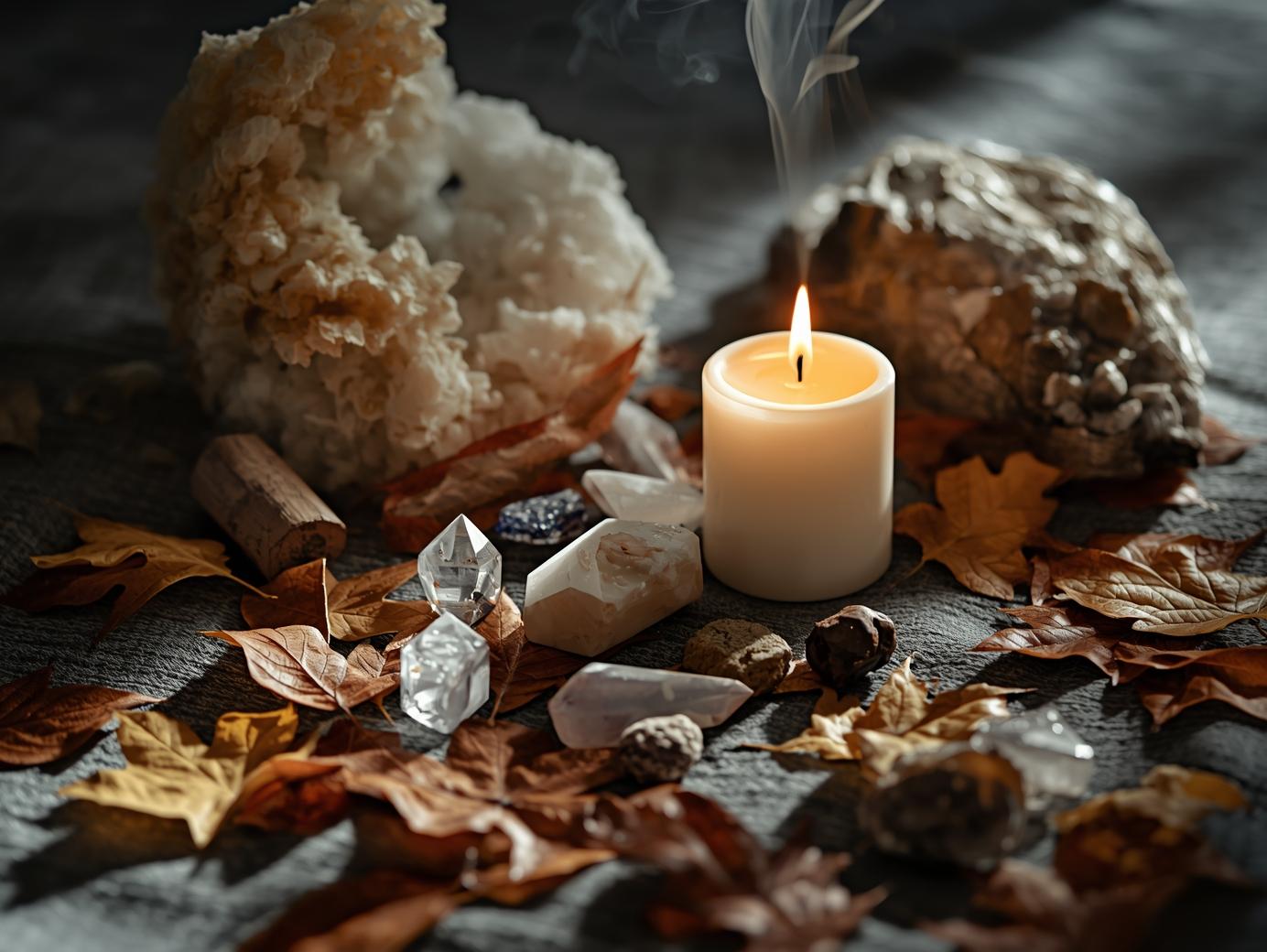
So light a candle tonight. Write down what you’re ready to release — an old story, a habit, a wound. Burn it, bury it, or whisper it to the wind. And when the flames fade, sit in that soft stillness and feel what remains.

It’s you. Not the brokenness, but the wholeness that’s been waiting underneath it all. The part of you that remembers — even the dark is sacred. 

A Simple Samhain Ritual of Awareness

  1. Prepare your space. Light a candle or some incense, and take a few deep breaths.
  2. Reflect. What patterns, memories, or attachments feel heavy? What has run its course?
  3. Write and release. Write these down on paper. Read them aloud with compassion — then safely burn or tear the paper, imagining the energy transforming into light.
  4. Welcome renewal. End with a gentle affirmation:

“I honor what has been. I release with love. I welcome what’s to come.”

Closing Thought

“The dark is not the absence of light, but the place where new light begins.”

Explore more soulful reads

More stories to nurture your spirit.

Pin It on Pinterest