When Shame Blocks Love: Returning After Emotional Flooding

When Shame Blocks Love: Returning After Emotional Flooding

When Shame Blocks Love

Returning After Emotional Flooding

There are moments in healing when love feels very far away.

Not because we no longer care about the people in our lives.
Not because connection suddenly stopped mattering.

But because something else has taken over.

Shame.

When Shame Closes the Door

Shame has a quiet but powerful effect on the nervous system.

It tells us we are too much.
Too broken.
Too difficult to be around.

When it takes hold, something inside begins to withdraw.

Part of us still longs for connection.

We want someone to sit beside us.
We do not want to carry everything alone.

And yet another part of us wants to disappear.

To hide.
To isolate.
To escape before anyone can see us like this.

These two impulses can exist at the same time.

The desire to be held.
And the fear of being seen.

When the Past Floods the Present

Sometimes shame arrives quietly.

Other times it comes with something much stronger.

Memories return suddenly.
Images, emotions, or body sensations that feel overwhelming.

The body reacts as if the past were happening now.

The heart races.
Breathing becomes shallow.
Muscles tighten.

Headaches, trembling, exhaustion, or confusion can appear.

In these moments it can feel as if the present moment has disappeared.

The Courage to Stay

Many people who experienced overwhelming situations in the past learned to survive by leaving.

Leaving the conversation.
Leaving the room.
Leaving the relationship.

Sometimes physically.

Sometimes emotionally.

And that response made sense.

But healing sometimes introduces a different possibility.

Instead of immediately running from the moment, we begin to slow things down.

We give ourselves time to breathe.

We name what is happening inside us.

Not the entire story.

Just the present moment.

Right now I feel fear.
Right now I feel shame.
Right now my body is overwhelmed.

These simple sentences can begin to reconnect us with the present.

Returning to the Body

When the nervous system is flooded, thinking alone often does not help.

The body needs signals of safety.

Sometimes those signals can be very simple.

A slower breath.

The feeling of the ground beneath our feet.

Noticing the chair supporting our weight.

Some people use grounding exercises like the 5-4-3-2-1 method, gently naming things they can see, hear, or feel around them.

Others find relief in writing down what they are experiencing in a journal.

None of these are perfect solutions.

But they can help the nervous system begin to remember that the present moment exists.

When Support Is Not Immediately Available

Not everyone has someone beside them during these moments.

And even when supportive people exist in our lives, we may not always be able to reach them right away.

In those moments, small anchors can still help.

A message to a trusted friend.

A support line.

A few sentences written in a notebook.

Even the quiet knowledge that somewhere in the world, others are walking through similar storms.

Sometimes the first step out of isolation is simply remembering that we are not the only ones who feel this way.

The Quiet Help of the Living World

For many people, nature can also become a gentle ally during these moments.

Not as a cure.

But as a stabilizing presence.

A walk outside.

The sound of birds moving through the trees.

The wind touching the skin.

Sunlight warming the face.

These experiences remind the nervous system of something simple and powerful.

Life continues.

The earth holds us whether we feel strong or fragile.

The forest does not judge.

It simply exists.

And sometimes that quiet presence helps us return, breath by breath, to the present moment.

Love Does Not Always Disappear

When shame is strong, it can feel as if love itself has vanished.

But often love has not disappeared.

It has simply become harder to access for a while.

Underneath the fear, the anger, and the exhaustion, the capacity to care is still there.

Sometimes we see it only after the storm has passed.

When the nervous system settles.

When we can look at the people beside us again and realize:

Connection survived the moment.

And so did we.

Explore more soulful reads

More stories to nurture your spirit.

Compassion Without Rescue

Compassion Without Rescue

Compassion Without Rescue

Staying Kind Without Losing Yourself

There is a quiet archetype that lives in many of us who grew up in unstable or toxic environments.

The watcher.
The mood-reader.
The emotional regulator.
The one who keeps the peace.

As children, we learned quickly:
If the atmosphere is calm, we are safe.
If someone is angry, unpredictable, or collapsing — danger is near.

So we adapted.

We scanned the room.
We adjusted our tone.
We softened conflict.
We tried to control what was never ours to control: other people’s emotions.

It was not manipulation.
It was survival.

But survival strategies do not always retire when danger passes.

When Compassion Turns Into Rescue

As adults, this early conditioning can quietly morph into something that looks noble:

We become helpers.
Supporters.
Fixers.
Rescuers.

We feel deeply.
We want to ease suffering.
We cannot bear to see someone in pain.

But here is the subtle truth:

Compassion says,
“I see your pain.”

Rescue says,
“Let me carry it for you.”

And carrying is heavy.


We Are Not Responsible for Another Adult’s Emotions

This is one of the hardest truths to internalize.

We are not responsible for:

  • managing someone else’s mood
  • preventing their discomfort
  • fixing their exhaustion
  • dissolving their grief

In fact, when we rush to make someone feel better, we may unintentionally invalidate their experience.

Not every pain needs to be removed.
Some pain needs to be witnessed.

The difference is subtle, but profound.

The Illusion of Control

In toxic family systems, children are often conditioned to regulate their parents.

To calm them.
To appease them.
To prevent explosions.

Safety depended on emotional management.

So of course rescue feels familiar.
It feels like love.
It feels like responsibility.

But often, it is fear wearing a gentle mask.

Fear of conflict.
Fear of abandonment.
Fear of not being needed.

The Hidden Cost of Rescue

When we rescue:

  • we step into over-functioning
  • we absorb what is not ours
  • we drain our own nervous system
  • we blur boundaries

And there is something else, even more important.

When we take over someone’s struggle, we remove their agency.

We silently communicate:

“I will do this for you.”
“You don’t have to.”
“You might not be able to.”

And while that may feel protective, it can rob someone of:

  • responsibility
  • growth
  • ownership
  • strength

Growth requires participation.
Healing requires agency.


Rescue as Avoidance

There is another layer many of us must face with honesty.

Sometimes, rescuing others is easier than sitting with our own grief.

It gives us purpose.
It makes us valuable.
It distracts us from the places inside that still ache.

We can spend decades being helpful.
Kind.
Needed.

And never look at the wounds that shaped us.

It is easier to save someone else
than to sit quietly with our own pain.

This is not judgment.

It is awakening.

What Compassion Without Rescue Looks Like

It sounds like:

“I hear you.”
“That sounds heavy.”
“You deserve support.”
“I trust you to take your next step.”

It feels like:

  • staying in your body
  • not over-functioning
  • not fixing
  • not absorbing

It is warmth without collapse.

It is kindness with boundaries.

The Shift

When we release the need to rescue:

  • our energy stabilizes
  • our nervous system softens
  • our relationships become clearer
  • our care becomes cleaner

We are no longer reacting from childhood fear.

We are choosing from adult awareness.

And perhaps most importantly:

We free ourselves.


A Closing Mantra

I can care without carrying.
I can witness without absorbing.
I can love without rescuing.
I can stay kind and stay whole.

Explore more soulful reads

More stories to nurture your spirit.

After the Work: Why Healing Needs Gentle Care Too

After the Work: Why Healing Needs Gentle Care Too

After the Work: Why Healing Needs Gentle Care Too

Holding ourselves after deep inner work

There is a quiet moment that often comes after the work is done.
After the therapy session.
After the deep conversation.
After the memory surfaces, the realization lands, the truth is spoken.

It’s the moment no one really prepares us for.

We expect clarity. Relief. Maybe even lightness.
Instead, what often arrives is fatigue. Fog. Tenderness. A strange sense of being emptied out.

And many people quietly ask themselves:

“What’s wrong with me? Shouldn’t I feel better by now?”

Nothing is wrong.

This is not failure.
This is integration.

Healing Doesn’t End When the Session Ends

Deep inner work doesn’t stop when the conversation is over.
It continues in the body. In the nervous system. In the places that have learned to stay alert for years.

When something long-held loosens, the system needs time to reorganize itself.
That reorganization can feel like:

  • exhaustion
  • emotional sensitivity
  • difficulty focusing
  • a desire for quiet or solitude
  • or even a sense of disorientation

These are not signs that you went “too far.”
They are signs that something meaningful has shifted.

The Forgotten Part of Healing: Aftercare

In many old traditions, healing was never a single act.

There was always a before — preparation.
And an after — rest, warmth, nourishment, containment.

Modern healing spaces often focus on insight, release, understanding.
But aftercare is where the work actually settles.

Aftercare is not indulgence.
It is not weakness.
It is wisdom.

The Witch Who Knows When to Rest

In old stories, the village healer didn’t rush back to work after tending the fire.
She knew when to cover the embers.
She knew when the body needed warmth more than answers.

This archetype still lives in us.

The part of you that knows:

  • when tea is better than talking
  • when silence is medicine
  • when doing less is the bravest choice

This is not avoidance.
This is self-attunement.

Gentle Ways to Care for Yourself After Inner Work

Aftercare doesn’t have to be elaborate.
It only needs to be intentional.

You might try:

  • a warm drink held slowly, with both hands
  • a quiet walk without headphones or goals
  • wrapping yourself in a blanket and letting the body soften
  • writing a few simple sentences: “This is how I feel right now.”
  • allowing yourself to do nothing — without justifying it

There is no correct ritual.
Only what helps you feel a little safer inside your own body.

You Don’t Have to Be Productive to Be Healing

We live in a world that measures worth by output.
But healing does not follow productivity rules.

Sometimes the most important work happens when nothing visible is being done.

When you rest after healing work, you are not stopping the process —
you are completing it.

A Gentle Reminder

If today feels quiet, slow, or heavy after deep inner work, let it be so.

You are not behind.
You are not broken.
You are listening.

And that is something to honor.


If your body has learned survival, rest can feel unfamiliar — even uncomfortable.
This is not something to fix, but something to meet gently.

You may return to this mantra whenever you need a reminder that being is already enough.

I am allowed to rest after healing.
Nothing is required of me right now.
What is changing inside me knows its own rhythm.
I am safe to soften.
I trust what is unfolding.

Explore more soulful reads

More stories to nurture your spirit.

Learning to Be Present When Stillness Feels Unsafe

Learning to Be Present When Stillness Feels Unsafe

Learning to Be Present When Stillness Feels Unsafe

There are days when nothing is asked of you.
No ritual to prepare.
No intention to set.
No next step waiting to be taken.

And yet, these are often the hardest days to inhabit.

We live in a world that quietly teaches us this equation:
movement equals worth.
Doing equals being enough.

So when there is no action to perform, no task to complete, no visible progress to show, something inside us begins to stir.
Rest can feel unfamiliar.
Presence can feel uncomfortable.
Stillness can feel like failure.

Not because we are doing it wrong —
but because many of us were never taught how to feel safe when nothing is required of us.

When presence feels harder than action

For nervous systems shaped by survival, calm is not neutral territory.

If your body learned early on that safety depended on alertness, adaptation, or pleasing others, then quiet moments can feel confusing — even threatening.
The absence of urgency may trigger questions like:

  • Why am I feeling uneasy when nothing is wrong?
  • Shouldn’t I be doing something right now?
  • What’s wrong with me if I can’t relax?

This is not a personal flaw.
It is not a lack of gratitude.
It is not a failure of spirituality.

It is a nervous system that learned to survive in motion.

When the world finally softens, the body may not immediately follow.

Rest is not inactivity — it is integration

After Imbolc, after the return of light has been felt, we enter a quieter threshold.
Not a time for pushing forward, but for letting the body catch up with what the heart has already sensed.

This is where presence becomes a practice — not a destination.

And presence does not mean perfect stillness.
It means gentle contact with where you are.

Sometimes that contact happens best through the body, not the mind.

Small ways to return to the present

If sitting quietly feels too much, that is okay.
Presence can be found in movement, texture, breath, and play.

You might try:

  • Walking in nature, without a goal. Let your attention rest on sounds, light, and ground beneath your feet.
  • Simple play — with an animal, a child, or even your own hands. Presence often returns through joy before calm.
  • Breathing with structure: slow inhales through the nose, longer exhales through the mouth, reminding the body it can soften gradually.
  • Touch-based grounding: holding a warm mug, a stone, a piece of fabric — something tangible to anchor you here.

None of these are meant to fix you.
They are invitations — ways of saying to the nervous system: You are allowed to be here.

When calm feels undeserved

One of the quiet wounds many carry is the belief that rest must be earned.

That if we are not producing, improving, or helping, we are somehow falling behind.

This is where the practice of allowing becomes essential —
the same allowing we explored earlier: letting ourselves be exactly as we are, without justification.

Presence is not a reward.
Rest is not a privilege.
Calm is not something you have to deserve.

Sometimes the most radical act is to stay with yourself when nothing is demanded.

A gentle reminder

If today feels empty, slow, or undefined, it does not mean you are lost.
It may mean you are integrating.

Nothing is asked of you — and that is not a void.
It is a pause.
A breath.
A place where something quiet can finally settle.

You do not need to fill it.


A small moment of grounding

Before you move on, you may wish to pause here.
This is not something to achieve or repeat perfectly.
Let these words land gently — during meditation, a quiet breath, or simply as you are.

I am allowed to be here.
Nothing is required of me in this moment.
My presence is enough.

Explore more soulful reads

More stories to nurture your spirit.

Walking With the Growing Light: Strengthening Intention Gently

Walking With the Growing Light: Strengthening Intention Gently

Walking with the Growing Light

Strengthening intention without urgency

The days are slowly growing longer.
The holidays have settled behind us, and everyday life is quietly returning — not yet rushing, not yet demanding everything at once.

This moment holds something precious.

Not momentum.
Not pressure.
But hope.

Hope Is Not the Same as Urgency

Hope is often confused with speed.
With action.
With the need to do something now.

But real hope is quieter than that.

It doesn’t shout.
It doesn’t push.
It doesn’t demand certainty.

Hope is the feeling that something can grow — even if it’s not visible yet.

And right now, this is the season of hope.

From Intention to Presence

During Yule, many of us reflected on what we wished to release, and what we wanted to carry forward. Those reflections didn’t ask for immediate results.

Now, as daily rhythms begin to return, we’re invited into a different kind of work — not planning, but strengthening intention through presence.

An intention is not a goal.
It is an inner direction.

It answers the question:
How do I want to meet this year?

Why Mantras Can Help Right Now

A mantra is not a command.
It’s not a promise.
And it’s not something you need to “believe in.”

A mantra is simply a reminder.

In moments when old habits rush back,
when urgency starts whispering,
when expectations grow loud —

a mantra gently brings you home.

Not through effort, but through remembering.

How to Work with a Mantra

Keep it simple.

Choose one sentence.
Return to it when you feel pulled away from yourself.
Repeat it once or twice — with the breath, not with force.

There is no right way to do this.
Only a kinder one.

Mantra Options for This Season

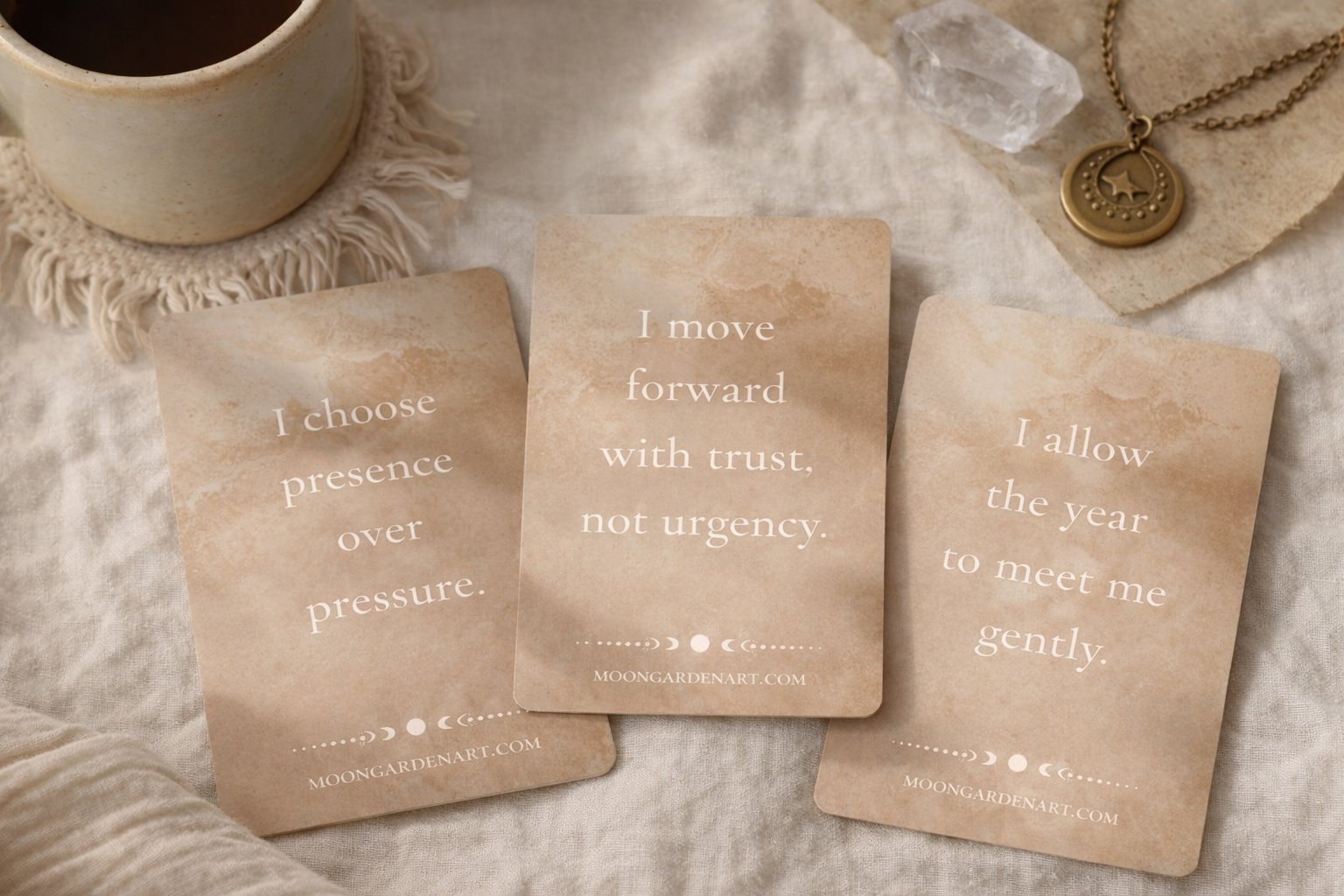
To support this gentle phase, I’ve created a small set of printable mantra cards.

They’re meant to be held, placed nearby, or returned to whenever urgency creeps in.

You can download them freely below.


Moon Garden Art Mantra mockup

Read them slowly.
Notice which one softens your body.
That’s the one to carry with you.

  • I move forward with trust, not urgency.
  • I allow the year to meet me gently.
  • I choose presence over pressure.
  • I don’t need to rush my becoming.
  • What is meant to grow will grow in its own time.
  • I walk with the growing light, at my own pace.

You don’t need all of them.
One is enough.

Let the Intention Be Gentle

This season is not about discipline.
It’s about kindness.

You will forget.
You will slip back into old rhythms.
You will catch yourself mid-pattern.

That doesn’t mean the intention failed.
It means you noticed — and noticing is already the work.

Hope doesn’t ask for perfection.
It asks for honesty.

Closing

The light is growing — slowly, steadily, without effort.

You don’t have to chase it.
You don’t have to force your way forward.

You can walk with it.
At your own pace.

If you’d like to carry one of these mantras with you, the printable cards are available here.

Explore more soulful reads

More stories to nurture your spirit.

Pin It on Pinterest