
THE CHRISTMAS GIFT EDIT Gifts for the Witch at Heart Moonlit Botanicals Personalized treasures for the moon lover, the nature soul, and the woman who...

It Is Safe to Be Unfinished
It Is Safe to Be Unfinished
Between Survival and StabilityThere is a season in healing that no one really talks about.
It is the space between survival and stability.
You are no longer living the old way.
You see the patterns.
You interrupt the reactions.
You refuse to collapse into familiar self-abandonment.
And yet…
The new way does not feel natural either.
There are no solid routines yet.
No effortless rhythms.
No stable identity to lean on.
Just effort. Awareness. Fatigue.
And sometimes the quiet question:
What now?
When the Old Is Gone — But the New Is Not Built
Survival mode is exhausting — but it is efficient.
It runs on automatic.
It is patterned.
It conserves energy because it is known.
When you choose something different, you step into conscious living.
Conscious living requires decisions.
It requires noticing.
It requires pausing before reacting.
It is neurologically expensive.
Of course you are tired.
You are not failing.
You are rewiring.
The “Let It Be Good Already” Trap
There is a voice that appears in this stage.
It says:
“Come on. You’ve done the work.
Why isn’t this easier?
Why aren’t you stable yet?”
This voice often sounds productive. Practical. Responsible.
But look closely.
It is the old survival system trying to reassert control.
It wants resolution.
Completion.
Certainty.
Healing does not move that way.
The old mode is fast — but unsafe.
The new mode is slow — but real.
And slowness feels like danger to a nervous system trained to scan for threat.
Why New Routines Feel So Hard
We are told that routines save energy.
And they do — once they exist.
But building new ones without a template is draining.
There is no muscle memory yet.
No inherited model.
No internal map.
You are learning how to live without fear as your primary motivator.
That takes patience.
It also takes enormous compassion.
Can You Rest Before It Is Perfect?
This is the hardest part.
How do you rest when the new structure is not stable?
How do you relax when you still feel vulnerable?
The answer is not “push harder.”
And it is not “trust the process” in a vague way.
The answer is smaller.
Micro-permission.
A conscious breath.
A short walk.
A cup of tea fully tasted.
One honest journal line:
“Today I am here.”
You do not need a finished life to rest.
You need moments of safety.
Safety creates structure — not the other way around.
The Swing Between Old and New
You may notice yourself moving back and forth.
Some days you operate from the new awareness.
Other days the old reflexes resurface.
This is not regression.
It is integration.
The direction matters more than the perfection.
And you already see the direction.
The Most Radical Shift
The real change is not that everything works smoothly.
It is this:
You no longer attack yourself for not being finished.
The old voice says:
“Why aren’t you ready?”
The new voice says:
“Of course this is tiring. You are growing.”
That voice is not weakness.
It is maturity.
It Is Safe to Be Unfinished
If you are in this in-between space —
no longer surviving, not yet thriving —
there is nothing wrong with you.
This stage is tender.
It is like new skin after shedding an old layer.
Sensitive. Exposed. Real.
You are not late.
You are not broken.
You are becoming.
A Grounded Mantra
You might sit with this for a moment:
It is safe to be unfinished.
It is safe to grow slowly.
Nothing is wrong with me for not being ready.
I am becoming, and that is enough.
Growth is not a race toward stability.
It is the quiet courage to stay with yourself even when the structure is still forming.
And that courage is already alive in you.
Explore more soulful reads
More stories to nurture your spirit.

Gifts for the Witch at Heart: A Christmas Gift Guide

Victorian Samhain Gathering Guide
Create an elegant Victorian Samhain gathering filled with candlelight, autumn abundance, meaningful remembrance and beautifully coordinated details.
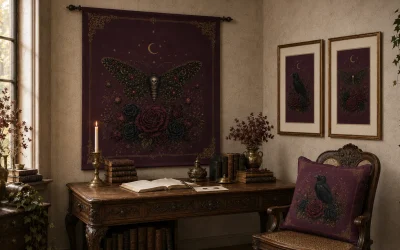
How to Create a Victorian Dark Academia Study Corner
DARK ACADEMIA LIVING How to Create a Victorian Dark Academia Study Corner Layered textures, mood lighting, and antique-inspired details come together...