Being Present in Uncertain Times: Why Awareness Comes Before Answers

Being Present in Uncertain Times: Why Awareness Comes Before Answers

Being Present in Uncertain Times

Why Awareness Comes Before Answers

We live in a time that constantly demands answers from us.
Clear opinions. Immediate reactions. Strong positions. Plans for the future.

Yet many of us are standing in a place where clarity hasn’t arrived yet — and forcing it only creates more tension inside.

Uncertainty presses from the outside, but the deeper exhaustion often comes from within:
from trying to respond before we are ready,
from trying to know before we have listened.

Sometimes the most supportive thing we can do — for ourselves and for the world — is not to hurry toward solutions, but to be fully present with what is.

The Witch’s Role in Times of Uncertainty

Historically, witches were not figures of control or prediction.
They did not promise certainty.

They were witnesses.
Listeners.
Midwives of transition.

They helped communities sit with illness, grief, birth, death, and change — moments when answers were unavailable, but presence was essential.

In uncertain times, the witch does not rush ahead.
She stays close.
She keeps the fire steady.
She reminds us that not knowing is not failure — it is a phase.

This is the role many of us are called into now.

Awareness Before Action

When the world feels unstable, our nervous system often wants immediate structure:
plans, routines, goals, productivity.

But healing rarely begins with planning.
It begins with awareness.

Before we ask:

What should I do next?

We might gently ask:

How am I actually living right now?

Not to judge.
Not to fix.
Only to notice.

Because we cannot create supportive routines until we understand the rhythms we already inhabit.

Turning Inward Instead of Outward

Many of us have been trained to orient ourselves outward:
toward expectations, crises, responsibilities, and demands.

Yet healing asks for something different.

It asks:

  • Can I be important enough to myself to listen inward?
  • Can I notice my needs without immediately overriding them?
  • Can I stay with my experience instead of escaping into solutions?

Practices like gentle yoga, breathwork, meditation, and journaling do not solve uncertainty —
They create safety inside it.

And safety is what allows clarity to emerge naturally.

A Simple Daily Practice of Presence

Rather than planning the week ahead, we can begin with a much smaller gesture.

At the end of each day, you might sit with a few quiet questions:

  • What felt supportive today, even in small ways?
  • What did I manage to do, despite everything?
  • Where did I feel a little more at ease?
  • What felt draining or heavy?
  • What might I need more of tomorrow?

These questions are not evaluations.
They are invitations.

Over time, they reveal patterns — not as rules, but as understanding.

Preparing the Ground for Gentle Structure

Eventually, routines and weekly rhythms can grow from this awareness.

But they are not imposed — they are grown.

When we listen long enough, we begin to notice:

  • when our energy rises and falls,
  • what stabilizes us,
  • what overwhelms us,
  • what truly nourishes us.

From there, structure becomes care — not control.

Staying With Yourself

In uncertain times, being present with yourself is not withdrawal from the world.
It is preparation.

A regulated nervous system, a compassionate inner dialogue, and an honest relationship with your own rhythms are quiet acts of resistance against chaos.

You do not need all the answers right now.

You need to be here.
With yourself.
One day at a time.

And that is already enough.

Explore more soulful reads

More stories to nurture your spirit.

Choosing Myself: Intention as an Act of Love

Choosing Myself: Intention as an Act of Love

Choosing Myself: Intention as an Act of Love

For a long time, intention did not feel safe to me.

It felt like longing — “it would be so nice if…”
Or like self-punishment — “why am I still not there, why am I not good enough yet?”

That is not intention.
That is hunger without ground.
Or discipline without kindness.

What was missing was something much quieter, and much stronger:

Commitment to myself.

Not as pressure.
Not as control.
But as a decision to stand beside my own life and remain present with it.

I once wrote about setting intentions as dreaming without limits — this reflection grows from that place, but speaks from deeper ground.

Setting Intentions with the New Moon – How to Dream Without Limits

When Wanting Was Not Allowed

When autonomy once came with abandonment,
when success was met with punishment or withdrawal,
the nervous system learns something very early:

Wanting is dangerous.
Choosing yourself has consequences.

So instead of intention, we learn to echo.
To listen outward.
To adjust.
To wait for permission that never really comes.

In that state, even our most honest desires feel fragile —
as if naming them might cause harm.

Intention Is Not a Wish

A wish says: “I hope something happens.”
Intention says: “I choose how I show up, regardless of the outcome.”

A wish floats.
Intention roots.

Intention is not a demand toward life.
It is an inner alignment — a direction you agree to walk, step by step.

Not because it guarantees safety,
but because it makes you present in your own life.

From Self-Judgment to Self-Commitment

For many of us, intention was confused with self-improvement.
With fixing.
With becoming “better” in order to deserve rest, love, or belonging.

But true intention does not ask you to erase yourself.

It asks:
Are you willing to stay with yourself — even when it’s uncomfortable?
Are you willing to choose presence instead of disappearance?

This is where intention becomes an act of courage.

This understanding of intention is closely tied to acceptance — not as resignation, but as presence. I explored this more deeply in an earlier reflection. The Truth That Emerges in Winter — Seeing Yourself Without Judgment


Intention as an Act of Care

To say:

  • I intend to be a “good enough” mother to my child.
  • I intend to heal — not perfectly, but honestly.
  • I intend to build autonomy and material stability, even when fear appears.

These are not goals to be measured.
They are commitments to relationship — with life, with responsibility, with care.

Intention does not promise ease.
It promises integrity.

Letting Go of Control, Without Giving Up Agency

Releasing control does not mean becoming passive.
It means releasing the illusion that everything must be forced.

Intention is where responsibility and trust meet.

You act where you can.
You release what you cannot command.

This is not weakness.
This is maturity.

Small Gestures, Repeated

Intention becomes real through small, repeated gestures:

  • returning to the breath
  • noticing resistance without shaming it
  • choosing rest when the body asks
  • speaking a boundary gently, but clearly

These gestures say:
I am here.
I matter.
My life is not something that happens to me — I am participating.

A Mantra for Practice

You may wish to sit with this as a short meditation, or return to it throughout the day:

It is good that I exist.
What I bring into the world has value.
I am capable of influencing my life —
through presence, choice, and care. 

Let the words land where they need to.
There is no rush.


Closing

Intention is not loud.
It does not demand certainty.

Sometimes it is simply the courage to remain —
to stop disappearing from your own life.

And that, in itself, is a profound act of healing.

Explore more soulful reads

More stories to nurture your spirit.

When Letting Go of Control Becomes Trust

When Letting Go of Control Becomes Trust

When Letting Go of Control Becomes Trust

There comes a point on many healing paths when effort alone is no longer enough.

We can learn coping skills.
We can reflect, journal, observe patterns.
We can work tirelessly to “do things right.”

And still, beneath all that effort, there is often a quiet tension — the feeling that if we loosen our grip, everything might fall apart.

For many of us, especially those shaped by early instability, control once felt like safety.
If I stay alert, if I anticipate every outcome, if I manage myself perfectly, maybe nothing bad will happen.

But control is heavy.
And it is also an illusion.

We can only ever truly guide ourselves — our choices, our responses, our willingness to stay present. Everything else unfolds in ways no amount of vigilance can fully predict.

The Illusion of Control and the Fear Beneath It

In recovery spaces, especially within 12-step frameworks, we often encounter the invitation to “turn things over to a Higher Power.”

For some, this language brings relief.
For others, it brings resistance, fear, or even grief.

When higher power is framed through rigid, hierarchical, or dogmatic images, it can feel like exchanging one form of control for another — one that demands obedience rather than offering safety.

But at its heart, this step is not about submission.
It is about trust.

Trust that life is not actively working against us.
Trust that we are held within something larger than our individual will.
Trust that letting go does not mean abandonment.

Reimagining the Greater Presence as Care

For many of us, the idea of feminine archetypes or goddesses feels more accessible, more humane, and more emotionally safe than traditional religious structures.

Not because they are superior —
but because they are relational.

They do not rule from above.
They walk alongside.
They do not demand belief.
They invite connection.

There is an old image that has stayed with me:

“The goddesses brushed the women’s hair. They walked among us.”

Not as distant symbols.
Not as figures of power and punishment.
But as quiet presences woven into ordinary moments of care.

Perhaps this is how trust returns — not through grand declarations, but through small, embodied experiences of being accompanied.

Trust as a Lived Experience

Letting go of control does not mean passivity.
It does not mean doing nothing or abandoning responsibility.

It means recognizing the difference between guidance and grasping.

When we loosen our grip, something unexpected can happen:
space opens.

In that space, we begin to notice signs — not as proof, but as reassurance.
A moment of calm where we expected panic.
A small alignment that arrives just in time.
A sense that we are not navigating life entirely alone.

Trust grows slowly.
Especially for those whose early environments made trust unsafe.

And that is okay.

Walking With, Not Handing Over

To trust something greater than ourselves does not require surrendering our agency.
It asks only that we stop carrying what was never ours to hold alone.

The archetypal feminine — whether named as goddesses, forces of nature, or inner qualities — offers a model of strength that is not built on domination, but on presence.

It reminds us that care is a form of power.
That intuition is a kind of intelligence.
That life continues to move, even when we pause.

A Quiet Invitation

Perhaps trusting the greater rhythm of life does not begin with belief.
Perhaps it begins with allowing ourselves to rest inside uncertainty without trying to conquer it.

To loosen the grip.
To breathe.
To let ourselves be guided — not commanded — by something gentler.

The path does not require certainty.
Only willingness.

And maybe, in moments we least expect, we will feel it —
that subtle sense of being accompanied,
as if someone were quietly brushing our hair,
reminding us that we are not alone.

Explore more soulful reads

More stories to nurture your spirit.

Walking With the Growing Light: Strengthening Intention Gently

Walking With the Growing Light: Strengthening Intention Gently

Walking with the Growing Light

Strengthening intention without urgency

The days are slowly growing longer.
The holidays have settled behind us, and everyday life is quietly returning — not yet rushing, not yet demanding everything at once.

This moment holds something precious.

Not momentum.
Not pressure.
But hope.

Hope Is Not the Same as Urgency

Hope is often confused with speed.
With action.
With the need to do something now.

But real hope is quieter than that.

It doesn’t shout.
It doesn’t push.
It doesn’t demand certainty.

Hope is the feeling that something can grow — even if it’s not visible yet.

And right now, this is the season of hope.

From Intention to Presence

During Yule, many of us reflected on what we wished to release, and what we wanted to carry forward. Those reflections didn’t ask for immediate results.

Now, as daily rhythms begin to return, we’re invited into a different kind of work — not planning, but strengthening intention through presence.

An intention is not a goal.
It is an inner direction.

It answers the question:
How do I want to meet this year?

Why Mantras Can Help Right Now

A mantra is not a command.
It’s not a promise.
And it’s not something you need to “believe in.”

A mantra is simply a reminder.

In moments when old habits rush back,
when urgency starts whispering,
when expectations grow loud —

a mantra gently brings you home.

Not through effort, but through remembering.

How to Work with a Mantra

Keep it simple.

Choose one sentence.
Return to it when you feel pulled away from yourself.
Repeat it once or twice — with the breath, not with force.

There is no right way to do this.
Only a kinder one.

Mantra Options for This Season

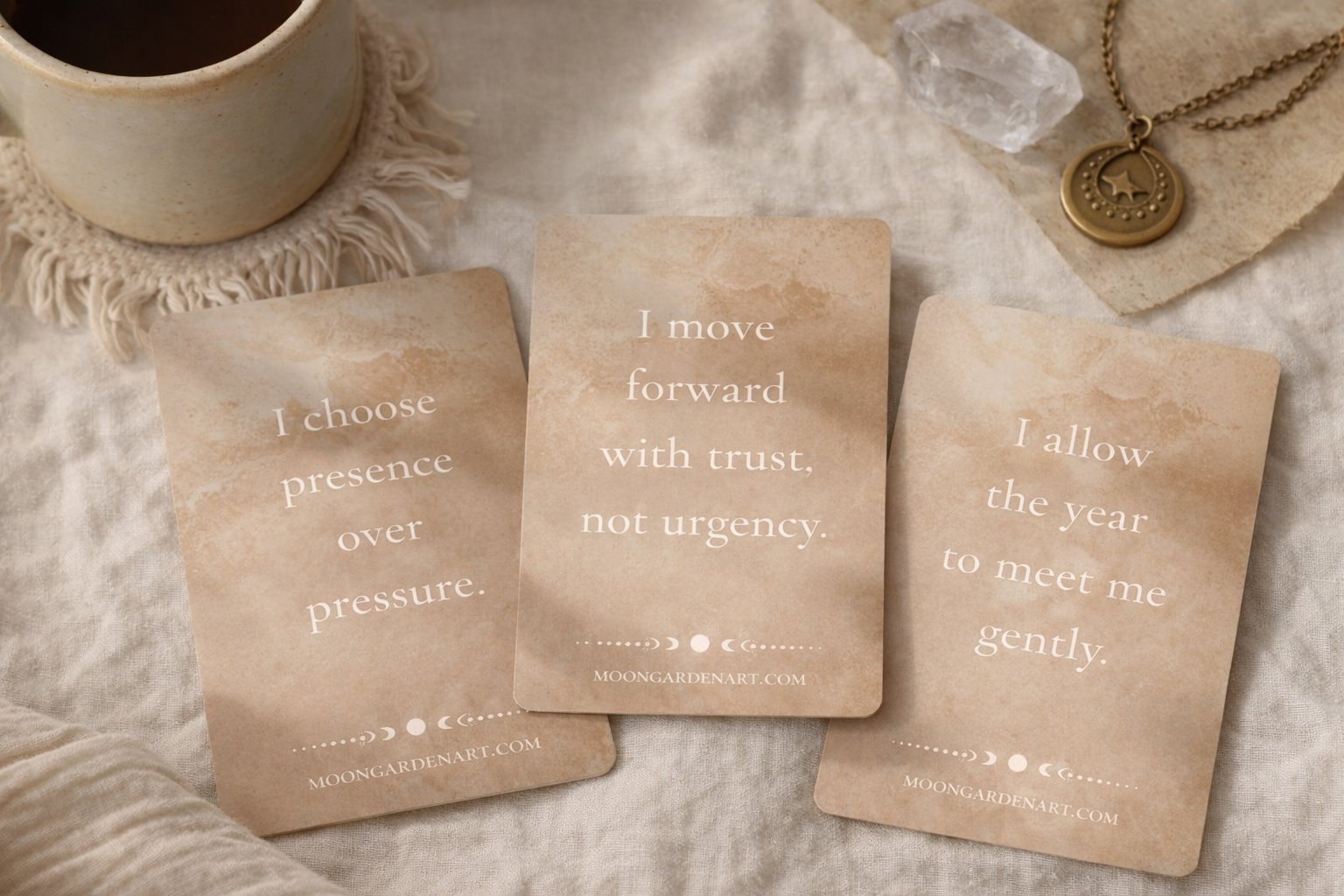
To support this gentle phase, I’ve created a small set of printable mantra cards.

They’re meant to be held, placed nearby, or returned to whenever urgency creeps in.

You can download them freely below.


Moon Garden Art Mantra mockup

Read them slowly.
Notice which one softens your body.
That’s the one to carry with you.

  • I move forward with trust, not urgency.
  • I allow the year to meet me gently.
  • I choose presence over pressure.
  • I don’t need to rush my becoming.
  • What is meant to grow will grow in its own time.
  • I walk with the growing light, at my own pace.

You don’t need all of them.
One is enough.

Let the Intention Be Gentle

This season is not about discipline.
It’s about kindness.

You will forget.
You will slip back into old rhythms.
You will catch yourself mid-pattern.

That doesn’t mean the intention failed.
It means you noticed — and noticing is already the work.

Hope doesn’t ask for perfection.
It asks for honesty.

Closing

The light is growing — slowly, steadily, without effort.

You don’t have to chase it.
You don’t have to force your way forward.

You can walk with it.
At your own pace.

If you’d like to carry one of these mantras with you, the printable cards are available here.

Explore more soulful reads

More stories to nurture your spirit.

The Truth That Emerges in Winter — Seeing Yourself Without Judgment

The Truth That Emerges in Winter — Seeing Yourself Without Judgment

The Truth That Emerges in Winter — Seeing Yourself Without Judgment

What the Full Moon Really Illuminates in the Dark Season

Winter does not arrive with a crash.
It slips in quietly.

The light fades. The nights stretch longer and longer. And somewhere between Samhain and Yule, we step into an ancient, inner landscape where the shadows grow softer — not because they disappear, but because we finally begin to see them.

This season asks something different from us than the bright half of the year.
Not action.
Not transformation by force.
Not positivity.
But truth.
Truth without the armor.
Truth without the performance.
Truth without punishment.

And when the Full Moon rises in winter, it doesn’t expose us to shame. It exposes us to ourselves.

1. Winter doesn’t break us — it reveals what’s been carrying us too long

The dark season has a way of bringing old stories to the surface.

Not because we’re doing something wrong.
Not because we’re “regressing.”
But because winter peels back the noise and shows us the raw, unfiltered truth of our inner world.

The things we avoid all year suddenly get louder:

  • childhood wounds that were never soothed
  • old survival patterns that once protected us
  • fears we tried to outrun
  • stories we built to survive… but not to live

This can feel overwhelming. It can feel like we’re “worse” instead of better. But what actually happens is simple:

Winter removes the distractions — and the truth grows clearer.

Just like in every old folktale, when the heroine enters the forest or the cave, she doesn’t meet monsters. She meets the parts of herself she abandoned.

What winter shows us is rarely comfortable.
But it is never meaningless.


2. Seeing without judgment: the real courage of the dark season

People talk a lot about “acceptance,” but they almost always mean the kind that comes with a beautiful realization:

“Oh, now I understand myself.
Now it makes sense.”

That version is lovely.

But it is not the whole truth.

Most of the time, acceptance looks much messier.

Sometimes you don’t understand.
Sometimes nothing makes sense yet.
Sometimes you feel empty instead of enlightened.
Sometimes you can’t look at your shadow — not because you’re unwilling, but because you’re tired.

And here is the part no one says aloud:

This too is acceptance — when you accept that today, this is where you are.

Acceptance is not a spiritual achievement.
It is not a sign of emotional perfection.
It does not require clarity.

It only requires honesty.

And honesty sometimes sounds like:

“I don’t know yet.”
“I feel resistance.”
“I can’t go deeper today.”
“I’m trying, but it’s hard.”
“I want to understand, but I’m scared.”

This is not failure.
This is truth.

**Even resistance is part of the truth.

And when we stop shaming ourselves for not being ready,
we finally become ready — gently, on our own time.**

Acceptance is not giving up.
It is simply ending the fight with reality.

And that is where growth quietly begins.


3. Why the winter full moon feels so intense

Many of us grew up believing that we are only lovable when we are:

  • stable
  • cheerful
  • productive
  • strong
  • “easy to be around”

So when winter brings up:

  • tiredness
  • irritability
  • old memories
  • emotional heaviness
  • or a sense of emptiness

…we panic.

We think we’re “failing.”
We think we’re “not healing fast enough.”
We think we’re “supposed to feel better by now.”

But winter doesn’t demand that we feel good.

Winter asks us to feel true.

And the Full Moon amplifies this truth — not to punish us, but to guide us:

✨ “You don’t need to be anything other than who you are right now.”
✨ “Your softness is not weakness.”
✨ “Your exhaustion is not a flaw.”
✨ “Your shadow is not your shame.”

Growth is not linear.
Healing is not seasonal.
And truth is not always comfortable — but it is always freeing.


4. A Winter Full Moon Practice — Seeing Yourself Gently

Here is a practice to help you meet your inner truth without judgment:

✨ Candlelight Truth Ritual

You’ll need:

  • a candle
  • a warm drink
  • a journal
  • a soft blanket or a quiet space

1. Light your candle.

Watch the flame.
Imagine it as the part of you that has always stayed alive,
even through your hardest seasons.

2. Place your hand on your heart and whisper:

“I accept where I am today.
This is enough.”

3. Now journal gently — without pressure:

  • What truth has winter shown me lately?
  • Where do I feel resistance?
  • If I’m tired, what is the tiredness trying to say?
  • What story from my past is asking to be heard?
  • What do I need, honestly, without judgment?


Warm candlelit close-up scene on a wooden wicca altar

4. Write one sentence that feels true right now.

Not perfect.
Not wise.
Just true.

Example:
“I’m overwhelmed, but I’m allowed to be.”
or
“I’m not ready to go deeper today — and that’s okay.”

5. Close with gratitude:

“Thank you for showing up as you are.”

This is enough for today.
More than enough.

Affirmation

“Even in the darkness, I am learning to see myself with gentleness.”
“My truth is not a threat — it is a beginning.”

Explore more soulful reads

More stories to nurture your spirit.

Tired but Growing – Soft Growth During the Waxing Moon

Tired but Growing – Soft Growth During the Waxing Moon

Tired but Growing – Soft Growth During the Waxing Moon

Winter deepens.
The nights stretch long, and with the holiday season approaching, the world around us seems to demand warmth, joy, sparkle, and “being okay.”

But inside?

Many of us feel the opposite.

Some feel exhausted.
Some feel strangely empty.
Some feel like old wounds have been ripped open.
And some feel the familiar ache of a childhood winter that was never about joy — but tension, fear, or loneliness.

If this is you, let me tell you softly:

You are not doing anything wrong.
And you are not alone.

The Waxing Moon is growing — but your growth does not need to be bright or energetic.
Sometimes the deepest healing happens when we feel most undone.


1. When inner growth brings exhaustion

There are moments on the healing path when an old pattern finally cracks…
and suddenly everything inside reorganizes.

A belief falls apart.
A survival strategy stops working.
A childhood illusion dissolves.

And what follows is not clarity.
Not peace.
But emptiness.

The identity you built to survive no longer fits — but the new one hasn’t formed yet.
This is why you may feel tired, detached, raw, or “not yourself.”

This is not failure.
This is a transition.

Your nervous system is working harder than you think.


2. “I should be okay by now…” — the voice born from unmet childhood needs

When you feel low-energy, overwhelmed, or emotionally fragile, a harsh inner voice may appear:

“Why am I like this?”
“I don’t have time to fall apart.”
“I have to pull myself together.”
“I should be happy — it’s the holidays.”

But this voice is not your truth. This voice is your childhood defense mechanism, formed when:

  • Your feelings were dismissed
  • You had to be “the strong one”
  • Love was conditional
  • Chaos made you grow up too fast
  • Rest or vulnerability was unsafe

So your system learned:
“I am only lovable when I’m okay.”

This belief is a wound — not a destiny.

And the winter Waxing Moon brings it to the surface so you can see it… and soften around it.

A woman watching a little girl

3. Winter + Waxing Moon: the season of slow, invisible strength

We’re taught that growth looks like:

motivation
clarity
focus
productivity

But in winter, growth looks like:

quiet integration
emotional honesty
allowing slowness
acknowledging pain
being with yourself gently

What strengthens us now does not look impressive.
It looks human.
Tender.
Honest.

The Waxing Moon is still inviting you to grow — but not upward. Inward.

4. The holiday season can reopen childhood wounds — and that’s not your fault

While many people celebrate, others carry a very different winter memory:

  • alcohol
    • shouting
    • coldness in the air
    • being ignored
    • being afraid
    • being the child who had to be quiet
    • or the child who took care of everyone else

For many, December is not “magical.”
It’s triggering.

You may feel pressure to “enjoy the holidays,” when your body holds memories of stress, chaos, loneliness, or emotional neglect.

And yes — these memories can return stronger than ever during winter. Not to punish you.
But because your system finally feels safe enough to reveal them.

This too is growth.


5. “Low-energy growth” — what the Waxing Moon asks from you now

You do not need a big breakthrough today.
You do not need clarity.
You do not need motivation.

Here is what the season is asking instead:

✨ Honor the pace your body chooses.
✨ Rest without guilt.
✨ Let your emotions speak.
✨ Validate the inner child who wasn’t allowed to feel.
✨ Grow gently, not forcefully.

This is true Waxing Moon energy in winter.
It’s not about becoming more.
It’s about becoming real.

6. A gentle Waxing Moon ritual for when you feel tired or emotionally raw

(low-energy ritual — soft, calming, grounding)

You’ll need:
• a candle
• a blanket or something comforting
• your journal
• and only a few quiet minutes

Step 1. Light the candle and wrap yourself warmly.

Imagine the flame as the part of you that never stopped growing — even on the hardest days.

Step 2. Place your hand on your heart.

Whisper:

“I don’t have to be okay to be worthy.”


A woman watching a little girl

Step 3. Ask yourself one question:

“Which part of me is asking for gentleness today?”

Don’t analyze.
Let the answer rise.

Step 4. Journal for 2 minutes only

(This keeps it simple and not overwhelming.)

Write:

  • What feels heavy?
    • What feels tender?
    • What feels true right now?

Step 5. Close your ritual by saying:

“I grow gently. That is enough.”

7. Affirmation

“Even in my tired moments, I am becoming more myself.”

Closing reflection

If you feel empty, exhausted, or emotionally overwhelmed right now…
you are not regressing.

You are healing.

And healing — real, deep, identity-level healing — often feels like fatigue before it feels like freedom.

Let this winter be the season where you stop judging your slowness
and begin trusting your softness.

Your growth is happening.
Even now.
Even like this.

Explore more soulful reads

More stories to nurture your spirit.

Pin It on Pinterest